
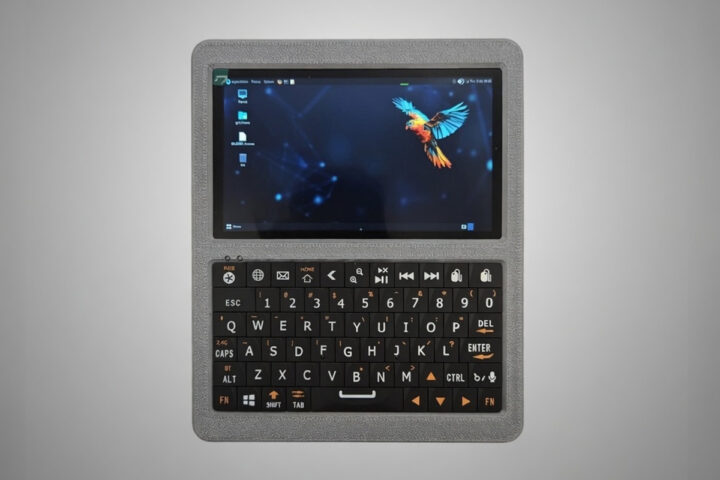

We previously wrote about Carbon’s CyberT, a Blackberry-style Raspberry Pi CM4 handheld Linux cyberdeck designed for Kali Linux and penetration testing. The company, now operating under the CyberArch/Carbon Computers brand, has introduced the Pi Slate, a more powerful handheld cyberdeck designed for portable computing and security-focused applications.
Built around the Raspberry Pi 5, the Pi Slate integrates a 5-inch 1280×720 touchscreen, a backlit RGB keyboard with an integrated cursor, and a 10,000 mAh battery for 3–5 hours of portable use in a compact enclosure. It supports modular expansion for HATs such as LoRa, SDR, AI accelerators, and M.2 storage, and includes cooling support, antenna mounts, and an optional modular back with a kickstand. It targets penetration testers, IT professionals, and field technicians needing a compact, preconfigured system for cybersecurity and field work.
Pi Slate specifications:
– SBC – Raspberry Pi 5 with 2GB, 4GB, 8GB, or 16GB LPDDR4X RAM options
– Storage
– MicroSD card slot (via Pi 5 standard ports)
– Support for M.2 NVMe storage expansions via the PCIe interface (HAT needed)
– Display – 5-inch HD IPS touchscreen display with a 1280 x 720 resolution
– Video output – 2x micro HDMI ports (via Pi 5 standard ports)
– Networking and wireless
– Gigabit Ethernet (via Pi 5 standard ports)
– Dual-band 802.11ac Wi-Fi 5 & Bluetooth 5.0 (on Pi 5)
– Optional LoRaWAN, SDR, and GPS support
– Antenna holes on the top corner
– USB
– 2x USB 3.0 ports (Pi 5 standard ports)
– 2x USB 2.0 ports (Pi 5 standard ports)
– 1x USB Type-C port, most probably for charging the internal battery
– 1x USB Type-C port for charging the keyboard
– 1x USB out port
– User Input – RGB keyboard with an integrated gyroscopic cursor
– Expansion
– Internal layout supports low-profile HATs, AI accelerators, and radio modules
– Slate Back module adds a fold-out kickstand and a hex mounting panel for accessories
– Misc
– Keyboard power switch
– Ring shape main power switch (Up off/ Down on)
– Flash light
– Battery button (single press battery status; triple press lights on/off)
– Battery indicator on the back side
– Built-in active cooling system designed to accommodate low-profile coolers alongside expansions
– Power
– 10,000 mAh internal battery for 3 to 5 hours of runtime
– Charges via the USB Type – C port
– Dimensions – 165 x 140 x 33 mm (6.5 x 5.5 x 1.3 inches)
– Weight – 574 grams (1.2 lbs)
The fully assembled versions are plug-and-play and require no setup. An accessible microSD slot allows quick OS swapping. The system ships with Raspberry Pi OS as the default option, but is fully compatible with Ubuntu, Parrot OS (featuring over 600 pentesting tools), TwisterOS, and Batocera for retro gaming.
There seems to be a lot of interest and activity around portable Linux cyberdecks and handheld terminals, and we’ve covered several over the years, including the ClockworkPi DevTerm, uConsole, and PocketTerm35, among others.
The Pi Slate is available for pre-order on the CarbonComputers store with a 1-2 week lead time. The barebones kit starts at $282.08, which feels a bit high for a Raspberry Pi-based handheld, while fully assembled versions range from $423.58 to $706.60 depending on the configuration. Optional add-ons, such as GPS/LoRa/SDR radio kits, are sold separately. The barebones option includes the chassis, display, keyboard, battery, and internal wiring, but you’ll need to add your own Raspberry Pi 5 and cooling.
The company also offers Pi Flux, a similar device with similar features, and both use a Raspberry Pi 5, have the same 5-inch display, built-in keyboard, and 10,000 mAh battery. The difference is mostly in the design, where the Pi Flux is built more like a rugged cyberdeck with extra mounting space and support for add-ons like antennas, radios, or other modules, while the Pi Slate is a slimmer, cleaner version that’s easier to carry around and feels more like a polished handheld device.