
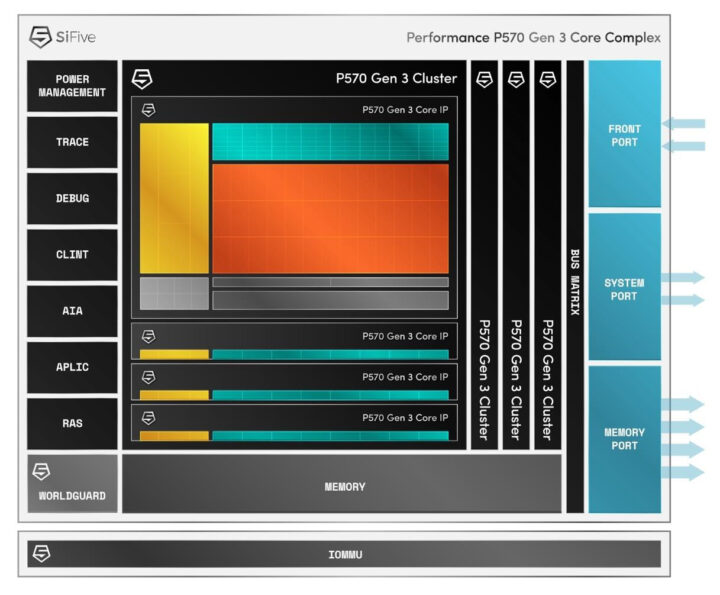

SiFive has introduced the SiFive Performance P570 Gen 3 RISC-V processor core, compliant with the RVA23 ISA profile and designed for edge AI, high-end consumer, and commercial IoT applications that run Android or enterprise-grade OS.
In addition to the CPU core, SiFive offers system IP, such as the advanced interrupt architecture (AIA) compliant with RISC-V standards, WorldGuard security, and a second-generation RISC-V standard-compliant IOMMU to build a complete SoC with up to 16 P570 Gen 3 cores.
Performance P570 Gen3 specifications:
- Supports all mandatory RVA23 profile extensions for compatibility with modern operating systems like Ubuntu 26.04 LTS and Red Hat Enterprise
- Includes extensions for enhanced security and performance, including Smepmp, Zvkng, Zvksg, Zicfilp, Zicfiss, Zfbfmin, Zvfbfmin, Zvfbfwma, and Zvdot4a8i
- Third-generation out-of-order core building on earlier P550 Gen1 and P470 Gen2 cores
- 3-wide, 13-stage fully out-of-order execution superscalar pipeline
- Single 128-bit vector pipeline with dot product extensions
- Supports multicore coherence with up to 16 cores in a core complex (4x 4-core clusters)
The P570 achieves twice the performance per GHz as the P550 in the Geekbench 6 benchmark and this increases to 21x higher performance for AI workloads such as object detection, due to the 128-bit VLEN vector pipeline. Compared to the P470 Gen2, the P570 shows 30% and 4.5x improvements. Photo filters like background blur also see significant benefits.
In traditional CPU workloads measured by SpecInt 2006/2017, the P570 shows 7-13% performance gains compared to the P550 and maintains the same performance as the P470.
The Performance P570 Gen 3 also provides efficiency enhancements with 13% and 5% dynamic power improvements (mW/GHz) compared to P550 and P470, and 51% and 5% power leakage improvements.
Software-wise, beyond support for modern OSs like Google Android, Canonical Ubuntu, and Red Hat, RISCstar has been working on upstreaming a full-featured implementation of OP-TEE in collaboration with SiFive and the RISC-V Software Ecosystem (RISE). Imagination Technology is also mentioned in the release, suggesting P570 SoCs may include the company’s GPU similar to other RISC-V SoCs.
Further details on the Performance P570 Gen3 RISC-V core can be viewed on the SiFive website, and in a video by Krste Asanovic, SiFive co-Founder and Chief Architect.