
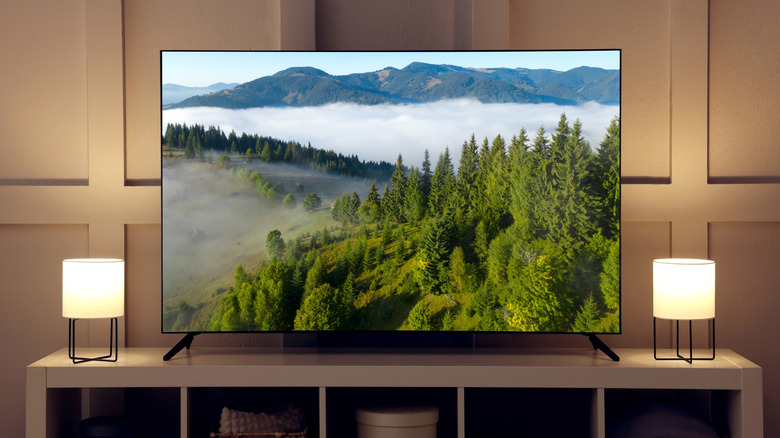

The television has been a fundamental part of home entertainment since the 1950s, with its technology advancing swiftly throughout the years. Nevertheless, one feature that has experienced a decrease is the number of buttons on television sets. Numerous contemporary TVs, especially smart TVs, possess few or no buttons, often situated in less-than-ideal locations. This transformation likely stems from the incorporation of remote controls and mobile applications, enabling users to manage their TVs without the necessity for physical buttons.
Manufacturers have not clearly articulated the reasons for the reduction of buttons, but the dominant theory is that the size and styling of smart TVs have impacted this development. As televisions become more streamlined with narrower bezels, there is reduced room for buttons. Some brands, such as Samsung, have tried out capacitive touch buttons and limited touchscreen capabilities, but these alternatives do not function as effectively as using a remote or a smartphone application.
The decrease in buttons is also attributable to the intricacy of contemporary TV installations. Historically, TV buttons were adequate for switching between a handful of channels and basic adjustments. Nowadays, with the surge of integrated applications, streaming services, and external devices like Amazon Fire TV Sticks and Rokus, navigating these choices with merely TV buttons would be awkward. Furthermore, sophisticated audio systems, like soundbars, add to the difficulty of using TV buttons for sound modifications.
In conclusion, the progression of TV technology and aesthetics, along with the growing complexity of entertainment systems, has resulted in the reduction of physical buttons on modern televisions. As remote controls and mobile apps keep providing more convenient and holistic control methods, the requirement for buttons on television sets may further decline.