
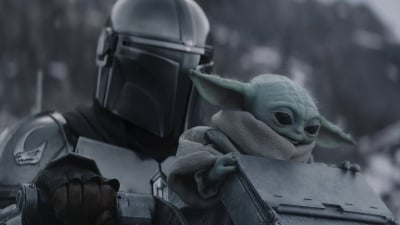

This is not the way.
By Belen Edwards on May 19, 2026
All products featured here are independently selected by our editors and writers. If you buy something through links on our site, Mashable may earn an affiliate commission.
It’s been almost seven years since a new Star Wars film hit movie theaters, but after watching Star Wars: The Mandalorian and Grogu, I think we should wait even more before giving it another shot.
It’s not that I don’t love to watch Star Wars on the big screen. I would just rather wait longer for a great, fresh Star Wars film to come along, and The Mandalorian and Grogu is certainly not that film.
SEE ALSO: 2026 Summer movie preview: Every film you need to know about now
The problem starts with the source material: TV series The Mandalorian. What began as a superlative space Western soon spiraled into a never-ending parade of references to other Star Wars stories, from the original trilogy to The Clone Wars to Rebels. The Mandalorian became nostalgia central, and a symptom of larger problems with Star Wars as a whole: The franchise is terrified to move beyond what fans already know. (Look no further than fans’ reaction to The Acolyte, and the show’s cancellation.)
That nostalgia is a tad less stifling in The Mandalorian and Grogu, which manages to weave in its fair share of former characters without totally hitting viewers over the head with it. However, the film is still a slog: an unwieldy adventure full of illegible action and the creeping sense of dread that we’ve seen this all before. Not even Din Djarin (Pedro Pascal) and Grogu’s sweet bond can Force lift it to success.
What’s The Mandalorian and Grogu about?
Following The Mandalorian Season 3, The Mandalorian and Grogu sees Din and Grogu working for the New Republic. Supervised by Colonel Ward (an underutilized Sigourney Weaver), they hunt down Imperial warlords still in hiding.
Their first quarry in the film holes up in possibly the grayest, most underlit room in the entire galaxy, a location that doesn’t quite raise your hopes for director Jon Favreau’s vision. Thankfully, their quest for their next target, the mysterious Commander Coin, will take them to far more interesting (if still somewhat drab) locales, from a crime-ridden, neon-lit metropolis on Shakari to the gooey tunnels of Nal Hutta.
Mashable 101 Fan Fave: Vote for your favorite creator today!
The latter is the home of the Hutt clan, currently ruled by the Hutt twins. (If you’re keeping score of The Mandalorian and Grogu’s references to other Star Wars properties, they showed up in The Book of Boba Fett.) These big ol’ space slugs are willing to cough up valuable information to the New Republic, but only if Din can rescue Jabba the Hutt’s very ripped son Rotta (voiced by Jeremy Allen White) from the Shakari fighting pits. (Add another reference to the tally: Rotta’s kidnapping was a key part of 2008’s Star Wars: The Clone Wars film.)
If the thought of The Bear’s White voicing a Hutt excited you, I’d advise you to lower your expectations. His voice is nearly unrecognizable, and his performance oddly flat. The dialogue he’s saddled with does him no favors. Twice, he gives almost the exact same monologue about how hard it was to have Jabba as a father, and how the fighting pits helped him step out from his shadow. Did writers Favreau, Dave Filoni (also LucasFilm President and CCO), and Noah Kloor not think we’d get it the first time?
The Mandalorian and Grogu’s action is underwhelming.
While we’re on the subject of Rotta, let’s get into the Shakari fighting pits. At one point, The Mandalorian sets up what should be an action slam dunk: an all-out brawl between Rotta, Mando, and the most dangerous creatures in the galaxy. What follows, though, is a confused slugfest with murky visuals, too many cuts, and no standout moments. Sure, each fighter gets a formidable introduction, but they ultimately lack individuality. (The film does get points for Rotta’s barrel roll.)
This winds up being the rule and not the exception for The Mandalorian and Grogu’s action sequences, especially group fights where Favreau struggles to keep up with multiple players. After a certain point, despite Ludwig Göransson’s impressive score amping up the energy, these battles become chores, especially when they stack up in the movie’s jam-packed third act.
A notable exception to this rule is the film’s snowy opening, which pits Din and Grogu against a squad of AT-ATs. It’s a dynamic leap