

Truecaller, a leading caller identification platform with over 500 million users, faces a more challenging phase as growth slows in its major market, India, and competition intensifies from telecom networks and smartphone platforms. India drives the majority of Truecaller’s growth, with over 350 million users accounting for about 70% of its global base, transforming the app from a basic caller ID service into a key communication tool.
To shape its future, Truecaller has launched features like AI Assistant and Family Protection to drive monetization and maintain relevance amid increasing competition. This competition arises as telecom solutions like Calling Name Presentation (CNAP) gain traction in India, and smartphone makers such as Apple and Google enhance their caller identification and spam-blocking features.
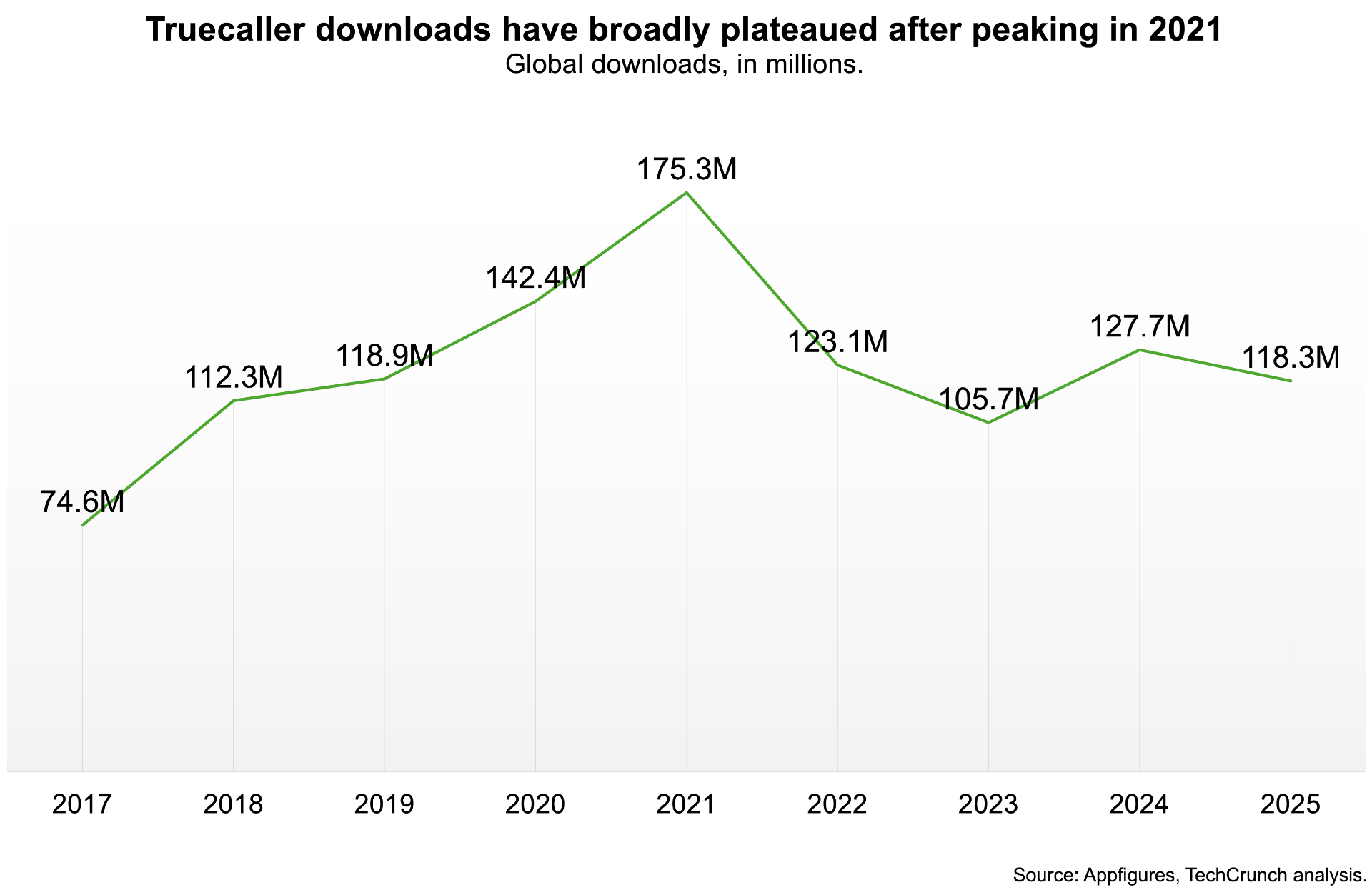
With rising competition, Truecaller’s growth is slowing. Sensor Tower data indicates a 16% decline in Indian downloads and a 5% global drop in 2025, reversing years of growth. Appfigures data shows a peak of 175 million downloads in 2021, with a sharp decline in 2022 and stabilization around 120 million annually. India remains Truecaller’s largest market, but its share of downloads has shifted from over 70% at its peak to the mid-50s as growth moves to other markets.
Truecaller’s evolving growth dynamics concern investors, with shares having fallen about 78% since its 2021 IPO and down 37% this year, highlighting investor worries about its growth outlook and business model. CEO Rishit Jhunjhunwala mentioned investor inquiries about CNAP’s impact in India and acknowledged challenges in certain business areas without providing details.
CNAP, advocated by India’s telecom regulator, displays caller names from KYC records at the network level but has a narrower scope than Truecaller’s core offerings. Jhunjhunwala views CNAP not as a disruption but as validation of the existing problem.
Bharath Nagaraj from Cantor Fitzgerald believes CNAP might slow user growth but won’t significantly disrupt Truecaller’s core business in the near term. He points to pressures from changes at Google affecting Truecaller’s advertising segment as a more immediate challenge since advertising accounts for 65%-70% of their revenue.
Truecaller’s drop in partner ad traffic in August 2025, attributed to an “algorithm issue,” indicates the need to diversify its revenue, with plans to build its own ad exchange and add new partners.
Despite advertising challenges, other parts of Truecaller’s business show a different trajectory. Appfigures data shows gross in-app revenue growing from $600,000 in 2017 to $39.3 million in 2025, with monthly in-app purchase revenue consistently above $2 million.
Truecaller’s iOS presence has also increased from under 5% of downloads in 2020-2021 to 11%-12% in recent years, indicating growth in higher-value markets. Efforts to enhance its iOS platform include launching real-time caller ID for iPhone and adding feature updates. Yet, Apple’s expanded call-screening capabilities could reduce the need for third-party apps among iPhone users.
Truecaller’s enterprise offering, Truecaller for Business, which verifies businesses and facilitates communication with customers, has seen steady growth, with revenue rising 39% in constant currency in 2025. The company is expanding globally, offering tools like verified business caller ID to help enterprises.
Consumers increasingly opt for Truecaller’s subscription service, which offers advanced spam protection, AI-based call screening, and an ad-free experience, with over 4 million paid subscribers worldwide.
Despite past criticism about its database practices, with questions about consent and data collection raised by The Caravan, Truecaller asserts compliance with regulations. It sees room for growth, aiming to address complex communication issues like sophisticated spam calls. Truecaller plans to expand all three revenue streams — advertising, enterprise services, and premium subscriptions — as standalone apps transition to network- and device-level solutions.