

It was a worthwhile detour. By Elisha Sauers on May 21, 2026.
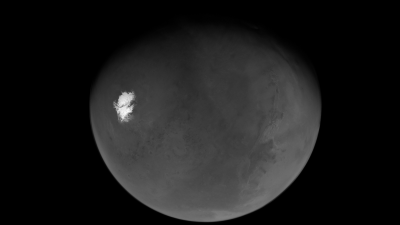
NASA’s Psyche spacecraft recently captured some unusual views of Mars, which might require a sideways glance. These images can play tricks on your brain. At first sight, the bright white feature seems less like a polar ice cap and more like the eye of a storm or a cloud bank on Mars’ edge. However, this glowing patch is actually Mars’ frozen south pole. As Psyche approached the planet at a steep angle on May 15, the familiar orientation shifted considerably, pushing the south pole to the frame’s side instead of the bottom.
The photos, taken while the spacecraft used Mars for a gravity assist toward the asteroid belt, provide the best view yet of the water ice-rich south polar cap. This frozen region spans over 430 miles, and Psyche captured it at a resolution of just over half a mile per pixel.
The flyby was more than just a photo opportunity. Psyche flew within 2,864 miles of Mars, using the planet to increase its speed by about 1,000 mph and redirect its path toward the metal-rich asteroid Psyche, which orbits between Mars and Jupiter.
Scientists are particularly interested in Mars’ south polar cap because there’s still debate about what’s beneath it. Radar observations have hinted at possible underground liquid water, while newer studies suggest the signals could come from buried rock or dust layers.
“This new data won’t settle the debate,” said Gareth Morgan, the lead author of research published six months ago about the ice cap, but “it makes it very hard to support the idea of a liquid water lake.”
In 2018, scientists with the European Space Agency’s Mars Express orbiter revealed evidence suggesting a buried lake under nearly a mile of ice, drawing global attention. However, new observations from NASA’s Mars Reconnaissance Orbiter complicated the picture. Using a more powerful radar technique, researchers found weaker signals than expected for liquid water, suggesting the readings might point to smooth rock layers or ancient lava flows beneath the ice.
The polar caps are crucial scientifically because they record Mars’ climate history. Comprising stacked layers of water ice, frozen carbon dioxide, and dust deposited over ages, these caps are akin to a history book, potentially preserving evidence of Mars’ changing conditions over billions of years.
Psyche’s flyby captured thousands of images of Mars and its atmosphere but was chiefly a rehearsal for its arrival at asteroid Psyche. Engineers calibrated cameras and other instruments during the close approach. The asteroid Psyche might be the exposed metallic core of an early failed planet, offering a rare glimpse into the deep interiors of worlds like Earth. Though the spacecraft won’t arrive at the asteroid for another three years, the team has plenty of time to monitor the planet in its rear view, according to Jim Bell, the Psyche imager instrument lead at Arizona State University.
“As the spacecraft continues its journey after the flyby,” Bell stated, “we’ll continue calibration imaging of Mars for the rest of the month as it recedes into the distance.”
Author Information: Elisha Sauers writes about space for Mashable, focusing on NASA’s lunar and Martian missions, interviewing astronauts, and covering history-making discoveries. With a background in journalism spanning 17 years, her work has earned numerous awards, including the Virginia Press Association’s top honor. Follow her on X at @elishasauers.