
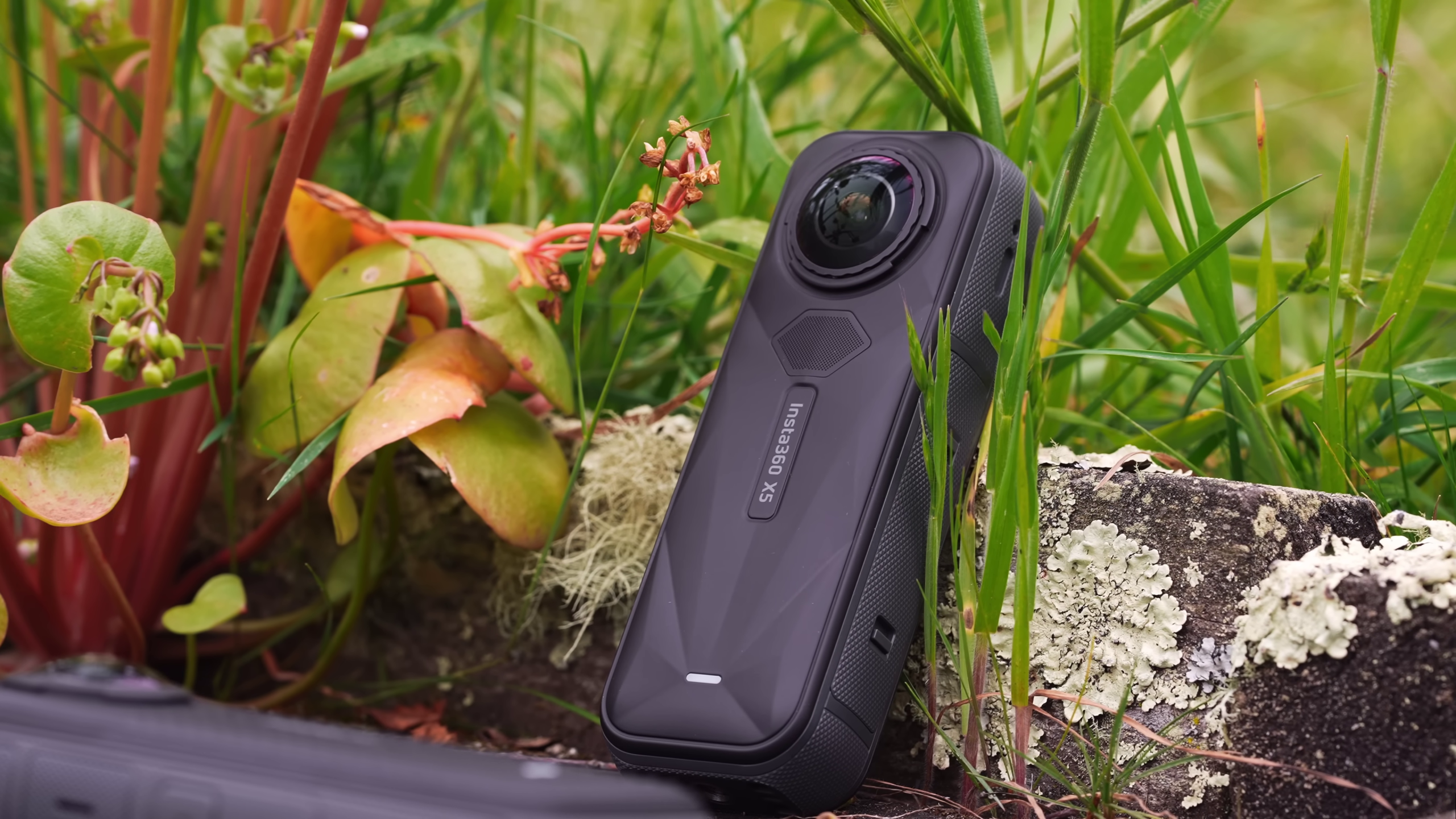

Insta360 cameras and Antigravity drones can use Gaussian splats to digitize little portions of the world. Imagine Google Street View, except you can walk around like a video game. Now imagine you don’t need to wait for Google to film because it’s completely DIY. Insta360, the leading maker of 360-degree cameras, is now partnered with a UK startup called Splatica to help creators do just that.
In January, we wrote about Gaussian splatting, the tech that promises to let anyone digitally recreate parts of the real world in photorealistic 3D. Splatica is making it easy to harness splats today with an off-the-shelf consumer 360-degree camera and a subscription service that handles everything else.
Here are the steps:
– Change two settings on an Insta360 camera or Antigravity drone
– Record a video while walking or flying around the area
– Sign up for a Splatica account and upload the video
– Wait a day for a miniature 3D world to appear in your web browser
I tried it with the Insta360 X5 camera and the Antigravity A1. While not perfect, splats look a bit ethereal, like stepping into a CG painting. Some creators and businesses might buy 360-degree cameras for this purpose alone. Insta360 cameras are already in demand for virtual tours, construction progress reports, and facility inspections.
Here’s my Antigravity A1 capture of a giant play structure in my local park. And the beat-up basketball hoop at another park down the road. Splatica edits out most people in the scene, so the park is a little emptier than in reality.
If you tap the path button in the upper-right corner, you’ll see the exact path I took with each camera to create these results. Splatica can recreate only what the camera sees, so you need to film from every place you might want to “stand” in the virtual world.
Below, I simulated a bridge inspection at the same park, focusing on one pillar underneath the BART commuter rail. It might lack enough detail for real surveyors due to the drone’s obstacle avoidance pausing my flight.
However, when I spent over five minutes capturing my own backyard with the X5, the expanded results made my wife and me not feel comfortable sharing the whole scan. Instead, Splatica generated a 3D point cloud of the backyard’s objects.
All scans can be downloaded in PLY and USDZ format and associated with real-world measurements. Co-founder Andrey Shelomentsev says there’s typically a one percent error every 100 centimeters. More accuracy can be achieved by placing markers around an area.
This isn’t my first 3D scan: in 2021, I tried it with a Skydio self-flying drone. Skydio charged $2,999 per year, not including a drone or service to stitch photos, while Splatica’s service does it all with a 360-degree video.
Splatica’s sample scenes are more interesting, proving companies can use its service to train robots before deploying them in factories worldwide. Here’s the Imecar Elektronik factory in Türkiye and part of the Leighton House in London.
How is this possible just by walking with a camera? Shelomentsev said the company built a proprietary SLAM version for accurate point clouds from 360-degree video. Point clouds are the “bones” of 3D objects painted with color.
Splatica can work with any 360-degree camera. Insta360 and Antigravity cameras have extra metadata in video files: lens distortion parameters, shutter speed, accelerometer and gyroscope data, and GPS — streamed from the Insta360 app to the camera during capture.
The Insta360/Splatica combo has limitations. Zoom into my examples to see translucent blobs of color instead of legible textures. High-res photogrammetry might better capture surfaces.
Insta360, Antigravity, and Splatica launched a marketing campaign called Project Eternal, a “global initiative” to preserve cultural landmarks. It offers prizes for the best Gaussian splats, 1,000 free Splatica uploads, and a project to scan Pompeii and Civita di Bagnoregio in Italy. They invite creators to scan Roman theaters and Korea’s Jeju Island.
They’re not helping creators secure permits but claims to maintain public access to any scene submitted to its “Open Heritage Dataset”. Insta360’s Richter says enterprise customers are piloting 3D reconstruction and digital twin workflows in construction and facilities management.
Splatica isn’t cheap. It charges 18 to 25 cents per second of processed video and requires a monthly subscription. Pricing ranges from $50 to $300 depending on the scan size. There might be 1,000 free slots waiving the subscription fee, allowing users to turn 10 minutes of 360-degree footage into 3D worlds. Explore