
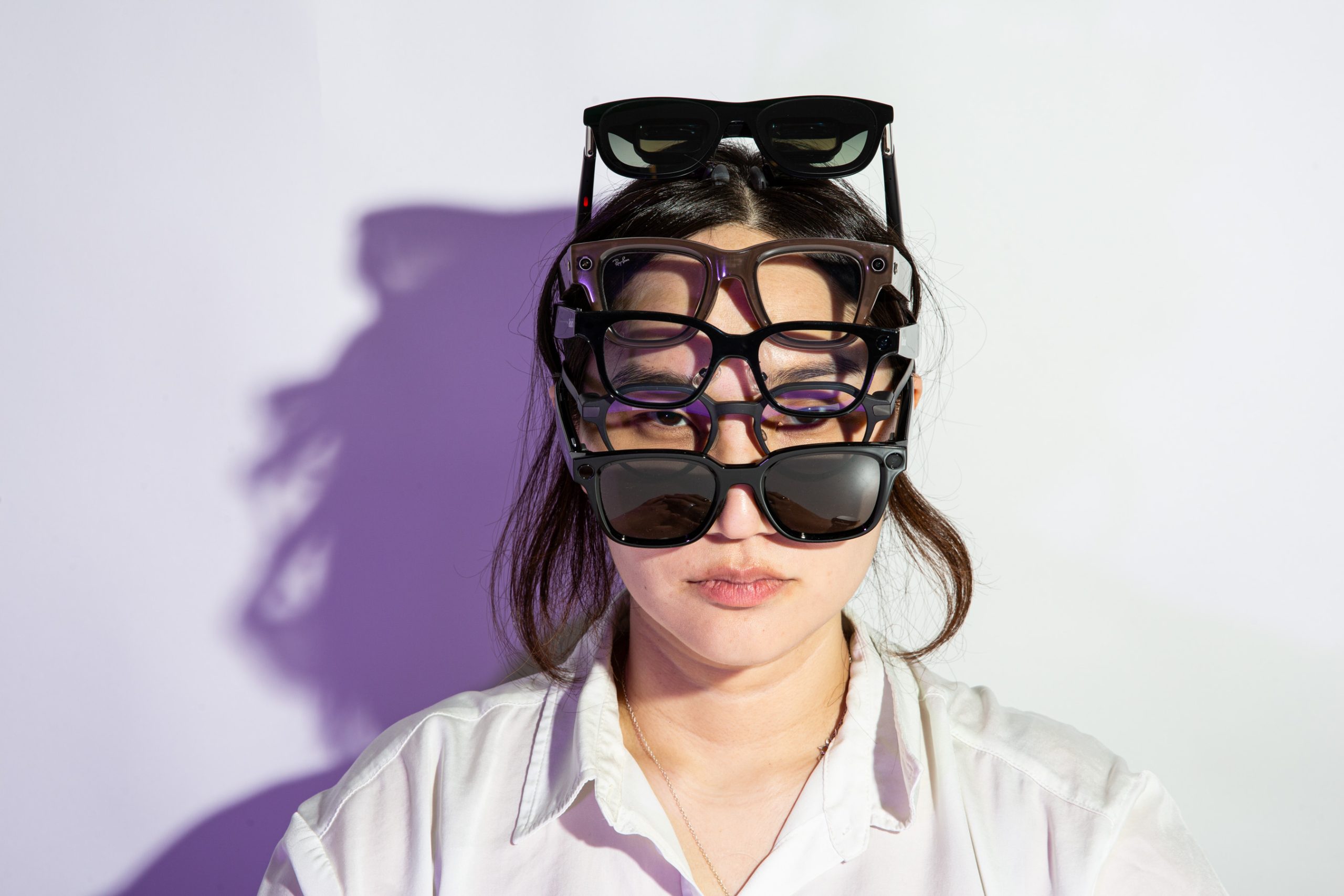

This latest batch of smart glasses is more stylish, affordable, comfortable, and capable than ever, yet they still don’t quite make sense. I’m wearing the Even Realities G2 smart glasses, with two more pairs from Rokid on my desk. Nearby, the Meta Ray-Ban Display glasses charge alongside their Neural Wristband. My closet houses six pairs of $50 smart sunglasses from Walmart, next to Xreal, RayNeo, Lucyd models, and an old pair of Razer Anzu. Later, I have an optician appointment to try the new Ray-Ban Meta Optics that might handle my complex prescription. I’m overwhelmed by smart eyewear, and even more options are on their way.
These devices are hard to differentiate right now; they all look similar and are equally unsubtle in bringing AI to your face. They’re filled with promises: they’ll enhance your health by tracking what you eat, increase your intelligence by capturing notes of everything you say, and boost creativity through transforming your environment into playlists and date ideas. However, after a year of testing, none have met these lofty claims. To find a permanent place on one’s face, smart glasses need a compelling reason to exist.
Wearing any modern smart glasses makes me feel like James Bond. With chunky Ray-Bans, I can stroll the neighborhood, listen to audiobooks, and read texts hands-free. I can discreetly get directions to a cafe if I fancy a coffee. With models featuring cameras or gesture controls, like the Even Realities G2 and Meta Ray-Ban Display, I secretively control a private display. I capture my cat’s antics unnoticed and feel like a wildlife documentarian.
Last summer, a stylish man praised my Oakley Meta HSTN glasses on a Williamsburg street. I also recorded a florist inadvertently with Meta Ray-Ban Display, feeling less civic-minded. “Good” smart glasses are defined by their discreetness and how much you can quietly accomplish, without anyone noticing. This makes them stylish and versatile for everyday wear. Fancier models offer privacy from public AI voice commands while retaining advantages.
Even Realities’ G2 glasses interact with a smart ring, allowing discreet use. I can view a teleprompter undetected. At LensCrafters, while fitting the Nuance Audio — glasses doubling as hearing aids — the optician imagined me as a “superspy” eavesdropping on all conversations. Unfortunately, like most gossip, the experience wasn’t fulfilling.
Recognizability is a risk both for the wearer and others in proximity. Public venues may start banning them, like cruises and courtrooms have. These concerns arise as tech invades privacy and people feel its creepiness.
Though the optimistic view is that these are the best smart glasses yet, the skepticism asks if that’s beneficial.
Finally, I don’t feel unattractive wearing current glasses. But using them consistently is hard. The AI technology they herald is mediocre for most. Meta AI is subpar, and glasses using alternatives atop ChatGPT aren’t much better. These AI features serve mundane tasks like music control or weather inquiries, but often drain batteries and falter for complex functions.
My spouse drags me to car shows to identify obscure models with Meta glasses. Meta AI struggles, often failing to recognize a Ferrari. At the Vatican Museum, it identified the Belvedere Torso, but without Wi-Fi, the AI was useless. Rokid’s AI complained about setup and Bluetooth issues. Lucyd glasses faced ChatGPT difficulties. Even Realities’ Conversate feature bombarded me with basic definitions during briefings.
During smart glasses demos, when inquiring about usage, I receive staged examples like choosing a book from a travel selection or generating a playlist from art. These scenarios seem forced. My books are a random mix; my meals depend on perishables, not AI suggestions. I play music according to my mood, not around art pieces.
Navigation aids work well until road systems thwart them. AI translations lack real-world practicality with their environmental needs.
Smart glasses are most practical during travel. Beyond some accessibility circles, they’re best suited for business travelers and content creators. Everyone else sees them as trendy headphones.
Companies push innovations desperately. As tech improves, they need to answer why we should wear them all day.
Smart glasses should primarily facilitate vision. It’s only recently that Meta added prescription support. From brands I’ve tried, only Even Realities assured compatibility with my prescription. They accommodate up to ±12, though overlook bifocals.
Since most don’t address my vision needs, deciding between contacts, contacts and smart glasses, or normal glasses is a daily choice. The time for lighter, prescription-friendly devices will come as the technology evolves, facing supply chain challenges similar to other wearables.
Even with intent to use smart glasses all day, eye dryness compels switching to regular glasses. If they break, repairs aren’t feasible compared to traditional glasses, producing costs difficult to justify. Moreover, right-to-repair questions arise.
Smartphones