

Australia’s Floating Solar Array Is Accomplishing Much More Than Producing Electricity
Australia’s water resources are diminishing. Researchers from Deakin University report that the nation’s water infrastructure suffers a loss of nearly 370 billion gallons annually due to evaporation, equating to around three times the volume of water in Sydney Harbor. However, the land down under has devised an innovative solution to safeguard its water supplies, which additionally aids in achieving the country’s zero-emissions objectives: floating solar power cells.
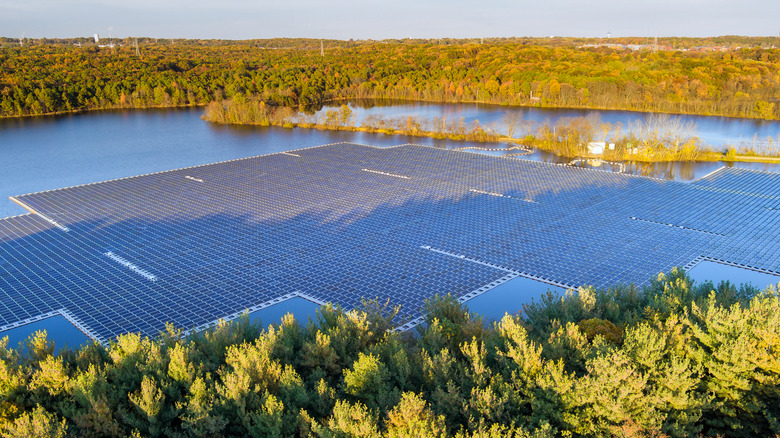
Referred to as floating photovoltaics (FPVs) or floatovoltaics, these large-scale floating solar panel installations are emerging across Australia’s dams and water reserves. By covering the surface of water bodies, solar panels significantly lower the evaporation rate. Importantly, this occurs without inducing algal blooms that compromise water quality, a frequent issue with conventional covers that obstruct excessive sunlight. Instead, these installations keep water supplies clean while contributing renewable energy to the nation’s electricity grids.
Certainly, solar panels are not a panacea for Australia’s energy or water challenges; nonetheless, their widespread adoption across the nation illustrates how municipalities and industrial stakeholders can tackle climate issues when given adequate funding and determination. Moreover, the solar initiatives highlight the interconnectedness of global climate challenges and the ancillary benefits of their solutions. While floating solar panels may not capture as many headlines as the solar moon-ring concept proposed by the Japanese company Shimizu, they could be a crucial component of the green energy solution.
Floating towards solar
Floating solar farms are gaining traction as a sustainable energy strategy, with floatovoltaics presenting numerous advantages over conventional solar installations. For instance, water serves as a natural coolant, an important benefit since solar panels’ efficiency diminishes with rising temperatures. Solar arrays utilizing bifacial panels, which absorb sunlight from both sides, further enhance efficiency by harnessing the light reflected off the water. As a result, floatovoltaics can outperform traditional arrays. The water conservation from these arrays amounts to more than just a secondary effect. Australian utilities have discovered that covering 70% of a reservoir’s surface with solar panels can reduce evaporation rates by more than half (via Bloomberg).
This could be particularly beneficial in rural agricultural regions, where canals and irrigation systems often waste substantial volumes of water. In California, for instance, researchers established that the state’s extensive 4,000 miles of aqueducts could save approximately 63 billion gallons of water each year by adding solar arrays. These findings contributed to California’s recent energy initiative, Project Nexus, which aims to install solar panels on the state’s agricultural canals.
Similar initiatives are progressing in Australia, where the installation of FPV infrastructure in agricultural regions is increasingly prioritized. For example, in 2025, the Australian Renewable Energy Agency allocated $8.5 million toward a five-year project to evaluate the technology’s feasibility in Australia’s agriculture sector. This venture is part of the Australian government’s Future Drought Fund’s Resilient Landscapes program, with plans to implement floating arrays across the agricultural irrigation infrastructure nationwide.
A burgeoning photovoltaic industry
Market analysts predict that the demand for such installations will rise significantly over the next ten years, largely due to the supportive stance of the Australian government. One illustration is the Warrnambool floating solar farm in Victoria. Completed in 2026, this array stands as the country’s largest, featuring 1,200 bifacial solar panels. Generating over 600,000 kWh of electricity yearly, the power produced by this array supplies the Warrnambool Water Treatment Plant and is anticipated to decrease the utility’s greenhouse gas emissions by more than 650 tons annually. Similar projects are emerging nationwide. Norwegian photovoltaics company Ocean Sun and Singaporean firm Canopy Power, for example, have collaborated to introduce 70-meter solar rings to Australian utilities.
Australia is not the sole country interested in deploying this technology. In reality, the nation’s collection of floating solar farms remains relatively small compared to other countries with more extensive investments in this technology, such as Japan. In 2016, Japan constructed what was then the largest floating plant with 50,000 photovoltaic panels. By 2019, Japan’s lakes housed 73 of the world’s 100 most significant floating solar plants. Since then, China has asserted itself as a global leader in solar energy, boasting several of the largest floating projects, including the 320 MW Dingzhuang solar farm. However, both South Korea and India are advancing solar projects that will exceed the Dingzhuang project. France, the Netherlands, Indonesia, Portugal, Taiwan, Norway, Italy, and the U.K. are also among the nations investing in floating solar power. In the U.S., the NJR Clean Energy Ventures in Milburn, New Jersey, stands as the continent’s largest floatovoltaic project.