
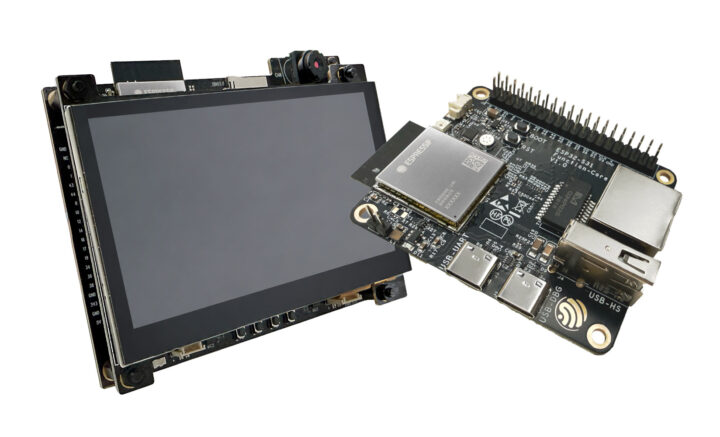

Two ESP32-S31 development boards are underway, with documentation already available. The ESP32-S31 was introduced last March, being the most feature-rich ESP32 wireless microcontroller to date. It offers two RISC-V cores, Gigabit Ethernet, 2.4 GHz WiFi 6, Bluetooth, 802.15.4 connectivity, LCD, and camera interfaces, among other features.
The ESP32-S31-Function-CoreBoard-1 development board uses the ESP32-S31-WROOM-3 wireless module. It provides Gigabit Ethernet, USB 2.0 OTG, and onboard audio peripherals for IoT applications.
The ESP32-S31-Korvo-1 is a multimedia-focused development board featuring a dual-microphone array for speech recognition and near/far-field wake-up, speaker connectors, a 4.3-inch LCD, a 3MP camera, and a microSD card slot. It targets affordable, low-power, connected audio/video, and HMI applications.
**ESP32-S31-Function-CoreBoard-1 Development Board**
Specifications:
– Wireless module – ESP32-S31-WROOM-3
– SoC – ESP32-S31NRV16
– CPU
– RISC-V HP RV32IMAFCP CPU @ 320 MHz with FPU, SIMD, etc.
– RISC-V LP core
– Memory – 512 KB SRAM, 16MB PSRAM
– Wireless – 2.4 GHz WiFi 6 (802.11ax), Bluetooth 5.4 with LE Audio, direction finding, Bluetooth Mesh 1.1, and Classic (BR/EDR), 802.15.4 radio for Zigbee, Thread, and Matter
– Storage – 8, 16, or 32MB flash (TBC)
– Antenna – PCB antenna
– Dimensions – 30 x 22 x 3.5mm
– Audio
– On-board microphone
– Speaker output port for up to 4 Ω, 3 W speaker
– ES8311 low-power mono audio codec
– NS4150B 3W mono Class D audio power amplifier
– Networking – Gigabit Ethernet RJ45 port via YT8531DC-CA PHY
– USB
– USB 2.0 Type-A high-speed port, up to 500mA
– USB 2.0 Type-C full-speed serial/JTAG port for debugging, flashing, and power
– USB Type-C to UART port for power, flashing, and communication with the ESP32-S31 chip via the on-board USB-to-UART bridge.
– Expansions – 40-pin J2 GPIO header
– Misc
– 2-pin J5 header for current measurement
– Reset and Boot buttons
– 3.3V power LED
– RGB LED (GPIO60)
– Power Supply
– 5V via USB-C port
– 5V to 3.3V DC/DC Converter
– TPS2051C USB power switch (up to 500 mA output current limit)
– Dimensions – 65 x 55 mm
A good USB 2.0 USB-A to Type-C cable and a computer running Windows, Linux, or macOS are needed for development. Refer to the documentation website for more details and sample requests.
**ESP32-S31-Korvo-1**
Specifications:
– Wireless module – ESP32-S31-WROOM-3, 16MB flash
– Storage
– MicroSD card slot (SDIO 3.0 capable)
– Quad SPI NAND flash footprint, multiplexed with microSD interface
– Display – LCD connector for ESP32-S3-LCD-EV-Board-SUB3 (4.3-inch, 800 x 480 resolution)
– Camera – Camera connector for 3MP OV3660 camera module
– Audio
– 2x speaker output ports, each with an NS4150B mono class-D amplifier for 4Ω, 3W speakers.
– 2x analog microphones connected to ES8389 low-power stereo codec with dual ADC/DAC, low-noise preamp, headphone driver, digital effects, analog mixing, and gain control.
– USB
– USB 2.0 Type-A High-Speed OTG port, up to 500 mA output current.
– USB Type-C UART port for power, firmware flashing, and communication with the ESP32-S31 via the onboard USB-to-UART bridge (up to 3 Mbps).
– USB Type-C port for power only
– Misc
– Power switch
– Reset and Boot buttons
– Function Buttons: PLAY, SET, VOL-, and VOL+ for