

**5 Iconic Sony Devices That Made The ’80s So Much More Awesome**
When it came to personal and household electronics in the 1980s, Sony was undeniably one of the leaders in the field. Its products were not only at the forefront of contemporary technology, but also perfectly represented the decade’s aesthetics and functionality. Classic gadgets like the Walkman and Handycam were not just excellent electronics, but also sleek, user-friendly, and incredibly stylish accessories to carry around.
It is largely due to Sony and its innovative devices that the unique spirit of the ’80s remains alive in our memories, even if the hairspray and leg warmers have faded. Furthermore, these gadgets laid the groundwork for future advancements, whether from Sony itself or other companies. It wouldn’t be an overstatement to claim that Sony’s innovations in the ’80s shaped the trajectory for personal, portable media in the years that followed, underscoring the lasting appeal of these devices.
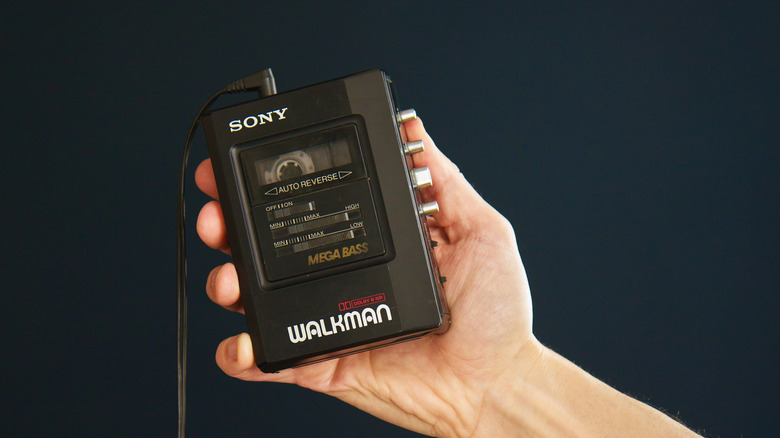
**The Walkman**
In the late ’60s, Sony introduced the original cassette tape recorder, the TC-50. Rather than for music playback, this device was designed for recording, with its integrated microphone assisting students and journalists in capturing significant moments. You can imagine the skepticism in 1979 when the very first Walkman was set to debut without a recording feature. There were concerns about whether users would embrace a device lacking that capability, but it ultimately transformed into one of the most celebrated portable music players ever, securing its status in the hearts of boomers as a quintessential ’80s gadget.
The Sony TPS-L2, popularly referred to as the Walkman, was a compact personal stereo. Sony’s co-founder, Masaru Ibuka, envisioned a simple way to listen to music on cassette tapes while journeying around the globe, prompting his request for a high-fidelity stereo device that he could carry. The Walkman debuted with a newly-designed pair of ultra-lightweight headphones, leading to a marketing campaign emphasizing music enjoyment anywhere and everywhere. The trendy youth of the ’80s quickly embraced the Walkman, and soon these little rectangles were ubiquitous, spotted on hips and in pockets worldwide.
**The CDP-101**
Before the ’80s, cassette tapes and vinyl records dominated music delivery, which partially contributed to the Walkman’s success. However, during this period, a new format, entirely distinct from the traditional cassette tape, began to emerge: the digital compact disc, commonly known as the CD. Although CDs are seeing a resurgence today, they were originally co-developed by Sony and Philips in the ’70s; as their storage capacity and sound quality improved, Sony anticipated that consumers would soon be listening to music via this format. To allow users to experience the new medium at home, Sony launched the very first compact disc player, the CDP-101, in 1982.
The CDP-101 became publicly available shortly after the CD format began gaining traction, providing a convenient method to play high-quality music. As a digital format, the CDP-101 featured numerous appealing characteristics, including instant track selection and playback time displayed on the device. The only drawback was its steep price, which is often the case with new technologies. Nevertheless, it served as a crucial test for the feasibility of digital audio in the consumer market and laid the groundwork for what followed.
**The Discman**
CDs began making their way into the consumer market around 1982, quickly challenging the supremacy of cassettes in portable music. The next logical step was to enable users to listen to CDs on the move. To proactively address this demand, Sony introduced the D-50, also known as the Discman, in 1984, marking the debut of the portable CD player.
The Discman was the result of a focused initiative by Sony engineers to design a CD player compact enough for portability without sacrificing functionality. The final product was about 4 cm thick, approximately the height of four CD cases stacked together, making it “portable” in the same sense as a boombox, rather than something that could easily fit in a pocket. Despite this, it found great popularity among music enthusiasts, further boosted by a more accessible introductory price, and helped solidify the CD’s position in the format rivalry.
**MDR-R10**
The ultra-lightweight headphones that came with the Walkman were