
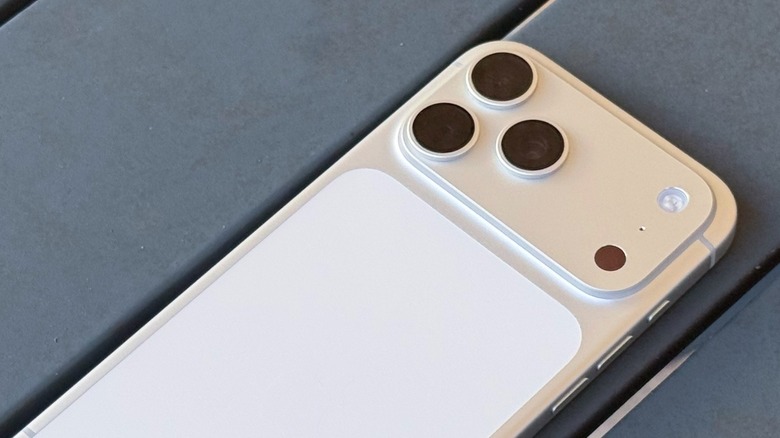

Occasionally, Apple devices make their way into outer space. For instance, NASA’s Perseverance rover operates on an older Mac chip. However, this is different from launching a product designed for Earth into space. As humanity returns to the Moon after half a century, it is noteworthy that NASA’s Artemis 2 crew brought along four iPhone 17 Pro Max units. Interestingly, it was NASA that provided the iPhones, not Apple. This arrangement allows Apple to enjoy unsolicited marketing, with some of the most breathtaking space photographs captured using iPhone cameras.
The New York Times reports that this marks one of the initial instances where NASA permitted astronauts to travel with smartphones. The crew received the new iPhones in March, prior to their quarantine period. Nevertheless, to reach this point, the space agency underwent extensive testing to evaluate how Apple’s iPhones would perform under such extraordinary circumstances. Typically, the approval process for new hardware is prolonged and involves four stages: presenting the hardware to a safety panel, identifying potential risks associated with it, devising a strategy to mitigate those risks, and demonstrating the effectiveness of that strategy.
NASA placed certain limitations on the use of the iPhones in space. According to the New York Times, astronauts are prohibited from using the iPhones for typical activities such as FaceTime calls, gaming, or any other connectivity functions. These devices are restricted from accessing the internet or utilizing Bluetooth — they are solely for capturing photos and videos.
This is necessary as NASA must authorize everything that enters a spacecraft. If the agency were to test the iPhone’s radio transmitter and its performance in a tightly regulated electromagnetic environment, it could lead to significantly longer testing durations.
Nonetheless, it is reasonable to believe that the four astronauts have many responsibilities during their journey to the Moon beyond merely using their phones. Even with their limited photo and video capabilities, the astronauts managed to take remarkable images of Earth and the Moon. NASA is simultaneously sharing stunning photographs shot with a Nikon on Instagram, Flickr, and various other social media platforms.
This initiative represents Apple’s most significant free promotional campaign to date. Whenever Apple unveils a new iPhone, it prominently showcases its camera features. The same occurred with the iPhone 17 Pro. In fact, the company quickly began to emphasize how this device would be utilized for the final 2025 Friday Night Baseball broadcast, assuring users of consistent streaming quality as before.
With this generation of iPhones, Apple also placed an emphasis on the 8x optical zoom, claiming that this technology is comparable to a 200mm focal length lens, while featuring a sensor that is 56% larger than that of the earlier model for the Telephoto lens. Another significant enhancement in this iPhone generation is the selfie camera, which Apple now designates as the Center Stage front camera, boasting up to 18MP resolution. This enables landscape photos to be captured without needing to rotate the iPhone, a feature the Artemis 2 crew utilized while in space.