
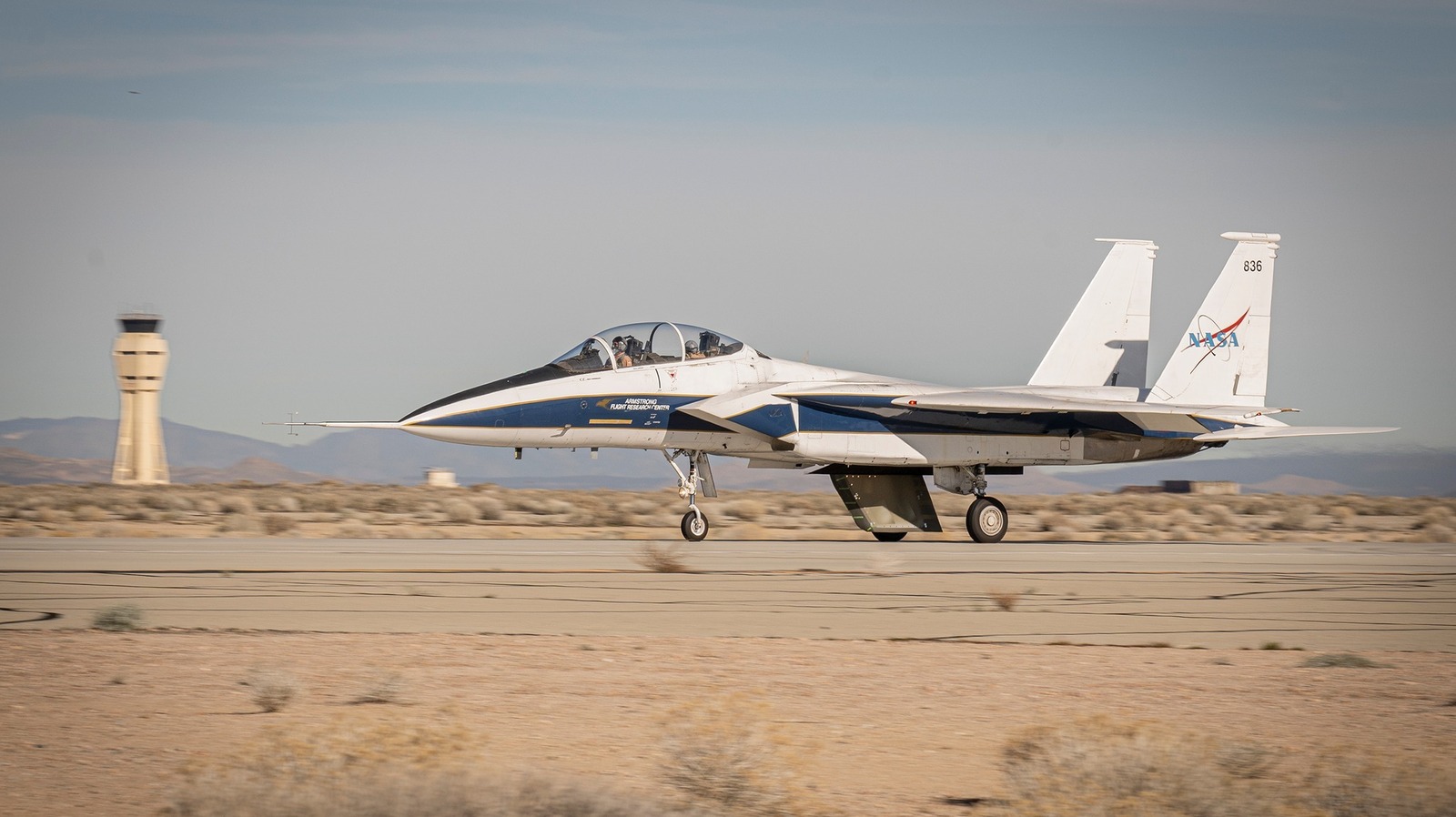

While NASA’s main emphasis has been on the unique Artemis II mission, it has been evaluating a novel wing technology that could save airlines a significant amount of money by cutting fuel consumption by up to 10%. This operates by preserving smooth airflow, referred to as laminar flow. Testing commenced on the ground and has now taken to the skies – but not on a commercial plane. The NASA team attached a three-foot scale model of a tailored wing beneath an F-15B to assess their Crossflow Attenuated Natural Laminar Flow (CATNLF) design.
In early January 2026, the test jet maneuvered around Armstrong Flight Research Center in Edwards, California, reaching speeds of 144 mph. Due to the vertical mounting of the test wing, there was no need to construct an expensive custom aircraft. By late January 2026, the jet ascended for a 75-minute flight that attained an altitude of 34,000 feet.
The objective is to sustain laminar airflow and minimize drag on commercial flights. Drag increases when airflow abruptly shifts, leading to friction that consumes fuel. Most commercial airplanes have large, swept wings that disrupt laminar flow. NASA states that researchers have been striving for decades to enhance airflow on swept wings, which is part of the agency’s initiatives to boost the performance of aircraft wings.
How this NASA initiative could save airlines millions
Fuel constitutes the airline industry’s largest operational expense, and NASA asserts that a 10% reduction in fuel consumption achieved with the CATNLF wing design would yield millions in savings for airlines. A typical Boeing 777 flight transporting 365 passengers from New York to London consumes 14,500 gallons of fuel, thus the design would conserve approximately 1,450 gallons per flight. Based on the summer 2025 price of $2.25 per gallon for jet fuel, that translates to roughly $3,200 in savings. Considering current rates, which exceeded $5.50 a gallon in Europe in April 2026, the savings would be significantly higher.
Over the span of an average year, an aircraft making daily flights from New York to London could save $1.2 million or up to $2.6 million at the current higher fuel prices. With more than 1,300 Boeing 777s in operation worldwide, potential savings could amount to hundreds of millions of dollars. Airlines could either pass these savings on to customers or reinvest in their fleets, as air travel demand may double over the next 25 years.
The design remains in its preliminary phases, so it won’t be featured on any airline flights immediately. NASA anticipates up to 15 test flights to determine how the CATNLF design performs under various speeds, altitudes, and conditions. NASA is hopeful that, if successful, the design could eventually be incorporated into the next generation of commercial aircraft or even supersonic planes, which are making a comeback in commercial aviation in 2026.