

**Introduction**
A critical component of AI-oriented GPUs is memory capacity. To effectively operate models, they must be housed in the memory adjacent to the GPU compute die. Since GPUs outperform CPUs in most AI tasks, this necessitates utilizing VRAM. Consequently, midrange professional GPUs intended for AI now feature larger memory buffers. For instance, AMD’s release of the AMD Radeon™ AI PRO R9700 last year, which transformed the 9070 XT into an AI card by increasing its VRAM to 32 GB, is illustrative. On the higher end, NVIDIA introduced a 72 GB version of its NVIDIA RTX PRO™ 5000 Blackwell.
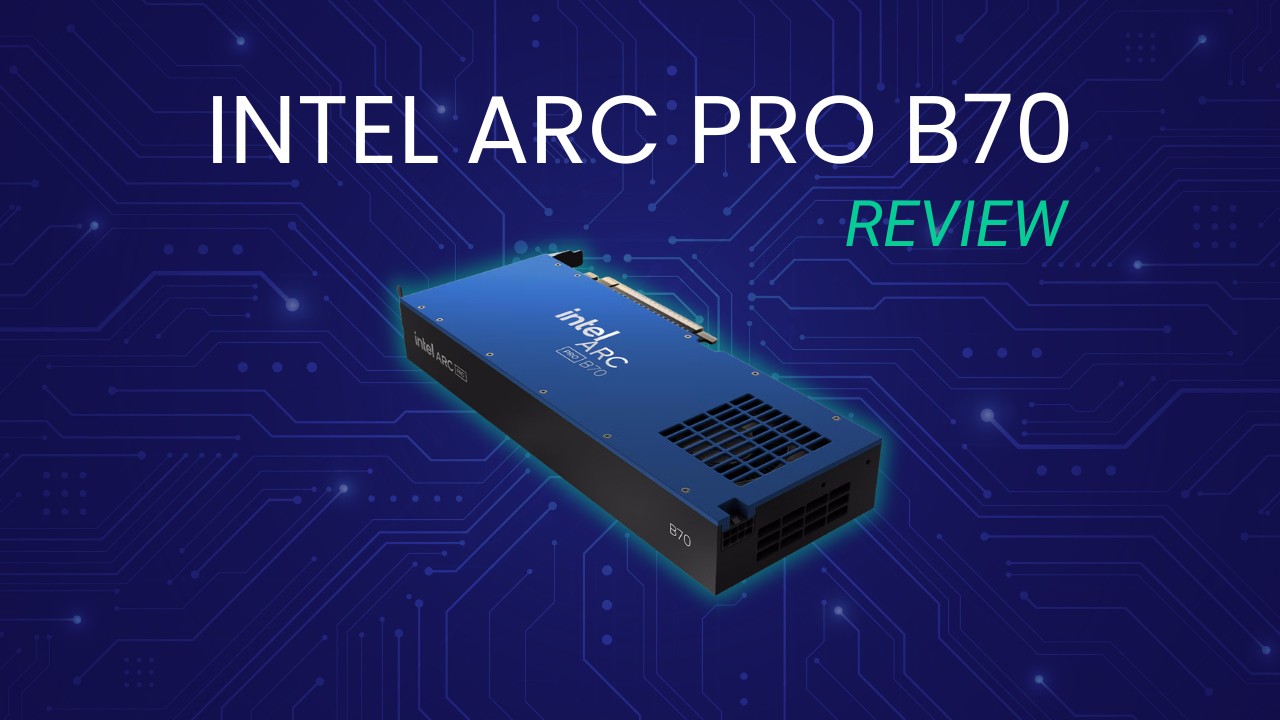
Intel has entered this arena with the debut of the Intel® Arc™ Pro B70. Unlike AMD and NVIDIA, who augment existing GPUs with more VRAM, Intel introduces a completely new product, the B70, which has double the Xe cores and VRAM compared to the Intel Arc Pro B50, reaching 32 GB of memory.
In earlier evaluations of the Arc Pro B50, significant strides over previous-generation Alchemist cards, such as the A50, were observed. The second-generation Xe2 architecture by Intel brought considerable improvements, ranging from SIMD16 execution to advanced XMX engines, boosting both raw performance and efficiency. Over the years, Intel has also refined support, compatibility, and driver optimizations to enhance already-released hardware performance.
Similar to the B50, the B70 incorporates dual media engines with an encoder and decoder, managing up to two 8K 10-bit tasks. Intel’s media engine supports a range of codecs, including HEVC 8-, 10-, and 12-bit (decode only) 4:2:0, 4:2:2, 4:4:4, alongside AV1, among others.
As a professional GPU, the Arc Pro B70 provides several features uncommon in consumer products, such as ECC memory and certified drivers that ensure stable and reliable performance across diverse professional software from independent vendors like Adobe, Autodesk, and Dassault Systèmes.
The Intel Arc Pro B70 features a larger GPU die than the B50 and other specification changes. Below is a table showing relevant specs for Intel, AMD, and NVIDIA GPUs:
Although not directly competitive alternatives to the B70 exist, it appears Intel has strategically undercut AMD’s R9700 by around 30%. Both the R9700 and B70 have 32 GB of VRAM and similar memory bandwidths. Still, on paper, the R9700 appears more capable, with double the FP32 performance and quintuple the matrix performance—though matrix performance calculations lack unanimous consensus. Comparing with NVIDIA, the B70 costs $200 more than the 2000 Blackwell, while offering double the VRAM and similar FP32 performance. Further up the spectrum, the 4000 Blackwell costs $550 more, and reaching NVIDIA GPU’s 32 GB VRAM, one must consider the significantly pricier 4500 Blackwell.
This review focuses on comparing the R9700, followed by the 2000 Blackwell, with occasional references to the B50 to demonstrate architectural scaling.
**Test Setup**
Utilizing an AMD Ryzen™ 9 9950X3D and ASUS ProArt X670E-Creator-based test bed in GPU reviews, a configuration deemed to provide optimal all-around performance and minimize CPU bottleneck risks. Latest GPU drivers and Windows settings, like VBS, were active. Tests employed standard professional productivity benchmarks: the Puget Bench suite, offline and real-time renderers like Unreal Engine, Blender, and Unigine, AI GPU benchmark in MLPerf, plus our standard Engineering test suite.
**Lightroom Classic**
The initial benchmark was Lightroom Classic. Overall (Chart #1), the B70 delivered a 12% improvement over the B50 but lagged slightly (by 3% or less) behind other GPUs. As Lightroom isn’t heavily GPU-accentuated, the expected performance change due to GPU wasn’t substantial. However, when examining AI effects (Chart #2), where GPU acceleration is apparent, more variation surfaced. The B70 achieved 27% faster results than the B50, trailing behind the 2000 Blackwell by 7% and the R9700 by 26%. Examining Export times (Chart #3), which do experience slight GPU acceleration, reveals that despite outperforming the R9700 slightly, performance differences were not significantly impactful.
While not recommended for Lightroom Classic, professional GPUs generally aren’t suggested for use here.
**Premiere**
Upon testing with Puget Bench for Premiere, the finding was that professional GPUs have limited value in many media and entertainment applications compared to consumer cards. The Overall score (Chart #1) showed the B70 56% faster than the B50 and 8% ahead of the 2000 Blackwell. It trailed the R9700 by 16% and the