
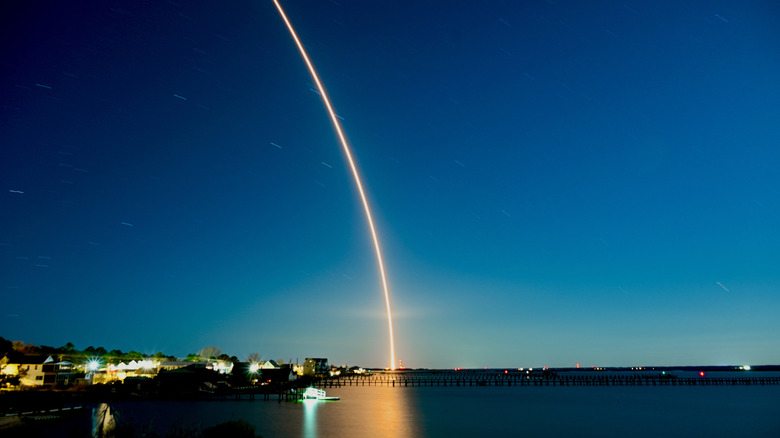

The U.S. Department of Defense has allocated $190 million to Rocket Lab’s cutting-edge HASTE launch vehicle — HASTE is an acronym for Hypersonic Accelerator Suborbital Test Electron — but what’s intriguing is that it is not intended for deep space missions. Rather, it is a low-atmosphere rocket based on Rocket Lab’s Electron Rocket, crafted for hypersonic test flights. A suborbital rocket, for those who might not know, does not attain orbital velocity, hence it returns to Earth without executing any orbits in outer space. This is in stark contrast to the company’s hypersonic rocket that has the potential to rival SpaceX.
A suborbital journey provides a low-gravity environment and facilitates suborbital research to undertake a diverse range of experiments and technology evaluations. This is exactly what Rocket Lab’s HASTE launch vehicle and its ensuing program aim to achieve. In collaboration with the DOD, Rocket Labs will “quickly enhance hypersonic flight tests and advanced aerospace technologies that will shape the future of defense operations.” This initiative is a cooperative effort between the DOD and the Naval Surface Warfare Center Crane Division, dubbed TRMC MACH-TB, or the Test Resource Management Center Multi-Service Advanced Capability Hypersonic Test Bed 2.0. Quite a lengthy title.
In total, this multi-million dollar agreement specifies 20 hypersonic test flights utilizing Rocket Lab’s vehicle over a span of four years. The initial launch in this series is expected to occur “within months” of the contract finalization, so it’s imminent.
What types of research can be conducted during a suborbital flight?
Some of the most significant U.S. space endeavors that were not orchestrated by NASA include suborbital launches, such as the U.S. Space Force’s X-37B orbital test vehicle. As stated by NASA, which also manages separate suborbital studies, numerous activities can be accomplished during these test flights, ranging from Earth science and geospace analyses to biological examinations, robotic evaluations, and recreating in-space experiences. Rockets and aircraft are not the sole means to achieve suborbital altitudes. Research balloons are similarly employed, including one the size of a vehicle that landed on a Texas farm.
However, Rocket Lab asserts that HASTE is “specifically designed for technology demonstration missions,” aimed at expediting relevant hypersonic research while minimizing related expenses and increasing launch availability and frequency. This is significant as conventional hypersonic testing approaches tend to be costly and sluggish in comparison.
The 20 HASTE missions currently planned will also emphasize “providing high-cadence hypersonic capabilities at scale for the warfighter,” fostering innovation for the military and the national security interests of the United States. Most further details are classified, but the research is poised to substantially benefit the armed forces. Importantly, the Mach 5 velocities that HASTE can reach present unique challenges for ground control. Should it be utilized for a more perilous, missile-based deployment, the speed is too rapid for assured tracking and targeting. It also necessitates quicker decision-making due to increased velocities. This represents a “critical technology area” that will yield “the greatest impact, fastest results, and most decisive advantage.”