
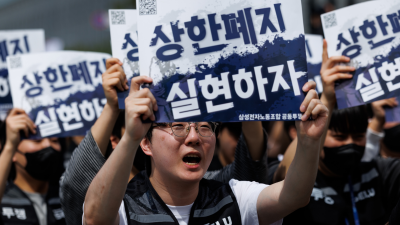

Over one-third of Samsung employees in South Korea may stage a strike this week, which could significantly affect the nation’s economy. Samsung has obtained an injunction that partially blocks a planned strike by its South Korean workers later this week. Despite this, it may not entirely prevent industrial action, with up to 50,000 Samsung employees prepared to leave their jobs this Thursday. If it proceeds, it would be the largest strike in the tech company’s history.
The workers’ action revolves mainly around disputes over bonuses. As reported by Yonhap, the union has demanded that Samsung allocate 15 percent of operating profits for performance-based bonuses and remove caps on those payouts while committing to a fixed calculation formula. Samsung reportedly offered to set aside 10 percent of operating profits for bonuses and provide a one-time special compensation package.
Initial talks fell apart last week after Samsung and the union couldn’t reach an agreement, according to Reuters. Last-minute negotiations recommenced on Monday, facilitated by the South Korean government. Unless an agreement is achieved, Samsung’s union workers are poised to embark on an 18-day strike starting May 21.
However, a new injunction will limit what workers can do during the strike. As Yonhap reports, the Suwon District Court ordered on Monday that Samsung’s union workers cannot seize company facilities or disrupt other workers. Staffing levels must be maintained for safety and security purposes, such as during necessary maintenance work to prevent equipment damage.
It’s currently uncertain how this will influence Samsung employees’ strike plans. While the injunction might have curbed the threat of industrial action, it hasn’t stopped it altogether.
The Samsung strike is a significant concern for the South Korean government. Samsung made up over 13 percent of South Korea’s GDP in 2024, according to Edaily media group, and is the country’s largest employer with over 125,000 employees. The planned industrial action is expected to involve over a third of this workforce and could have a substantial impact on South Korea’s economy.
“Just one day of suspension at Samsung Electronics’ semiconductor factory is expected to incur direct losses of as much as 1 trillion won [approximately $US667 million],” Prime Minister Kim Min-seok said on Sunday, as reported by the South China Morning Post. “What is more concerning is that a temporary pause on semiconductor manufacturing lines leads to months of inactivity.”
Kim further stated that if Samsung and the union cannot agree, the government will consider issuing an emergency arbitration order under South Korean law. Per The Korea Times, this allows the labor ministry to suspend any strike action for up to 30 days if it “is deemed likely to seriously harm the national economy or disrupt the daily lives of citizens.”
South Korean President Lee Jae Myung addressed the issue on social media on Monday. “Workers must be able to receive fair compensation for their labor in return for providing their services, and shareholders who bear risks and losses through their investments share in the company’s profits,” Lee wrote on X, translated by the platform. He added, “Under the current Constitution, the fundamental rights of all citizens are guaranteed, but they may be restricted within the scope that does not infringe on their essential content for the sake of public welfare and other reasons.”
Samsung recently announced its operating profit for Q1 this year was ₩57.2 trillion (approximately $US38.1 billion), an “all-time high” driven by the demand for AI chips. This marks a significant increase compared to the same quarter last year, when Samsung’s operating profit was ₩6.7 trillion (approximately $US4.4 billion).