
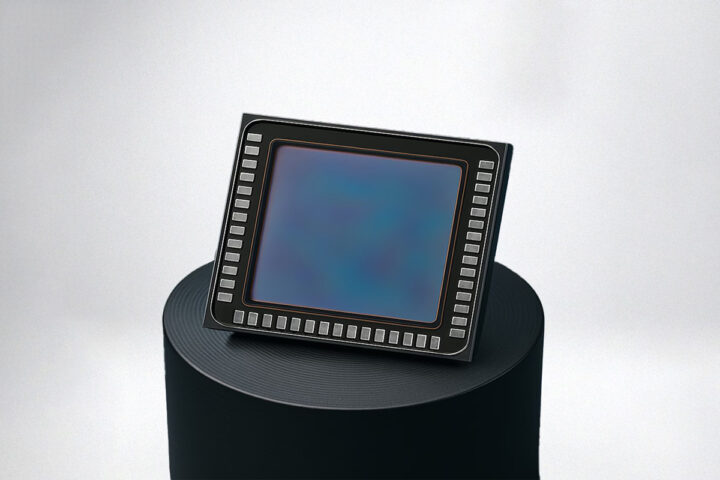

STMicroelectronics’ VD65G4 and VD55G4 are ultra-low-power 0.56-megapixel global shutter CMOS image sensors designed for battery-operated edge AI and always-on vision applications.
The main difference is that the VD65G4 features an RGB Bayer pattern for color, while the VD55G4 is a monochrome sensor for capturing visible to near-infrared (NIR) light. Both use a compact 1/9-inch optical format and a 2.16 µm pixel pitch, employing Back Side Illuminated (BSI), CDTI, and 3D stacking technologies for a small 2.73 x 2.16 mm bare-die footprint.
STMicro VD65G4 and VD55G4 specifications:
– Resolution: 0.56 MP (804 x 704)
– Chroma:
– VD65G4: RGB Bayer (RGGB)
– VD55G4: Monochrome (Clear, Visible to NIR)
– Optical Characteristics: 1/9-inch (2.3mm) optical format, 30° linear CRA, near 1:1 aspect ratio
– Pixel Technology: 2.16 µm x 2.16 µm pixel size with global shutter, BSI, CDTI, and 3D stacking
– Frame Rates: Up to 184 fps at full resolution, 271 fps at VGA, 480 fps at QVGA
– Dynamic Range: 68 dB
– Output Formats: RAW8, RAW10
– Interfaces:
– Data: MIPI CSI-2 (1-lane), I3C, or SPI (1-lane)
– Control: I2C (up to 1 MHz) or I3C (up to 12.5 MHz)
– Miscellaneous:
– Hardware autoexposure
– Automatic dark calibration
– Noise reduction
– Defective pixel correction
– Gamma correction
– Background removal (image difference mode)
– 4×4 programmable frame statistics
– Context management (up to 4 contexts)
– Power:
– VCORE: 1.1 V
– VDDIO: 1.2 V or 1.8 V
– VANA: 2.8 V
– Consumption: 35 mW typical @ 60 fps, 1-2 mW in auto wake-up mode, 0.8 mW in standby
– Dimensions: 43-pin bare die in reconstructed wafer, 2.73 x 2.16 mm footprint
– Temperature Range: -30°C to 85°C
The sensors are ideal for wearables, AR/VR headsets, and smart home appliances, consuming 35 mW at 60 fps and featuring an “auto wake-up” mode drawing just 1 to 2 mW. ST markets them as a low-power alternative to PIR sensors in smart IP cameras to reduce false alerts. The sensor can autonomously detect motion, activating a primary camera only when needed, preventing continuous 24/7 video streaming.
ST includes several on-chip hardware features to ease processor load, such as autoexposure and noise reduction. The sensor also generates frame statistics, manages multiple contexts, and removes background on-chip.
For development, ST is creating the CAM-65G4 and CAM-55G4 Promodule evaluation camera modules and the VD65G4 and VD55G4 S-Boards, which will soon be available online.
The P-Board (STEVAL-CAM-M0I1) is a development kit for connecting ST BrightSense camera modules. It features a MIPI CSI-2 output, I²C control, and easy integration with devices like Raspberry Pi and STM32. It supports interchangeable promodules with various sensors and lenses.
Additionally, ST offers the EVK Main (STEVAL-EVK-U0I1), a USB-based evaluation kit for PC testing. It includes a main board with USB-C (USB 3.0) output and a mechanical holder. A quick setup with STSW-IMG501 software is provided for live streaming and testing, supporting both ready-to-use promodules and custom setups with M12 lenses via S-Boards.
ST is developing a complete SDK with drivers and evaluation software. Although the software is not yet available, hardware sensors and datasheets are offered. The SDK will eventually include drivers for platforms like STM32 and Raspberry Pi, example code, user manuals, and step-by-step guides to accelerate edge AI and embedded vision projects.
The VD55G4 and VD65G4 sensors are currently in preview status and not available through distributors. However, development boards can be purchased, with the STEVAL-CAM-M0I1 P-Board priced at around $38.18 and the STEVAL-EVK-U0I1 EV