Contrasting USB Port Speeds: Blue versus Black

USB-C connectors are widely used, yet PCs still retain traditional USB ports, making it beneficial to understand the meaning of each color. So, if you’re examining your PC’s back and questioning the distinction between a blue and a black USB port, here’s what you ought to know.

When you encounter a black USB port on your PC’s back or side, it indicates compatibility with the USB 2.0 Hi-Speed standard. However, don’t let the term “Hi-Speed” confuse you. It was considered high speed when the standard was introduced back in 2000, featuring a maximum data transfer rate of 480 Mbps, but it pales in comparison to newer legacy USB ports that utilize USB 3.0, which boasts a maximum data transfer rate of 5 Gbps. Conversely, blue USB ports are compatible with the USB 3.0 standard, which is significantly more recent and quicker, although still somewhat older since it was released in 2008. The blue hue may also signify support for USB 3.2 Gen 1, although it’s typically red on most devices, providing double the data speeds of the original 3.0 standard.

The color of USB ports doesn’t always reveal the full picture

Top 5 Bluetooth Speakers Perfect for Your Home Gym

covering the area with stylish exercise gear. It’s also about establishing the right atmosphere, one that encourages effective physical activity, and perhaps reflects your individual style. A major element of that is a sound system connected through one or more speakers, and it’s in home gyms that Bluetooth speakers particularly excel. You can discover all the Bluetooth speakers you need on Amazon, supported by feedback from the site’s users.

Bluetooth speakers are a practical, budget-friendly choice for a home gym compared to a complex multimedia setup. You can easily move and position them anywhere in the space, quickly sync them to your phone for simple access to your music collection, all while maintaining audio quality. If you’re searching for one or more Bluetooth speakers for your growing home gym, you’ll find many alternatives on Amazon, each boasting a user rating of at least 4 out of 5 stars to guarantee it meets your demanding requirements.

Oontz Angle 3 Bluetooth Speaker

If your home gym is only just spacious enough for a few weights and a yoga mat, choosing a large, pricey Bluetooth speaker might not be the wisest option. Something compact and portable, yet still capable of producing excellent sound quality, would likely be a sound investment. For a budget-friendly choice for a smaller gym, consider the Oontz Angle 3 Bluetooth Speaker, available on Amazon for $24.99.

This lively little polygon delivers 12W stereo sound, providing high-quality output that maintains clarity even at full volume, a valuable feature for being heard over

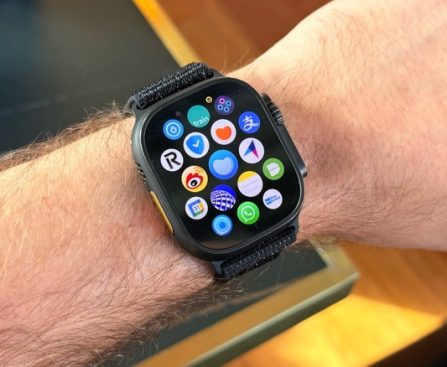
Grasping the Yellow Circle Indicator on Your Apple Watch

With the numerous capabilities integrated into the Apple Watch, it requires a battery that can handle those functionalities over an extended period. This is exactly what Apple has provided with its latest smartwatch collection. The latest Apple Watches can last from 18 to 42 hours between charges when including sleep time, allowing you to maximize their use. However, irrespective of the typical longevity of the Apple Watch’s battery, it will eventually deplete, potentially at the most inconvenient moments.

If you’re looking to extract more usage time from the smartwatch, there are several clever tips and tricks available to enhance the Apple Watch’s battery performance—one of which includes a yellow circle in your status bar. This yellow circle indicates that Low Power Mode is active on your Apple Watch. It is akin to your iPhone’s battery icon changing to yellow. With Low Power Mode enabled, your Apple Watch Series 11 can extend its active time from merely 24 hours to an impressive 38 hours. It accomplishes this by deactivating features such as background blood oxygen monitoring, gestures, and Always On display. However, Low Power Mode on the Apple Watch does not activate automatically; it must be enabled manually.

How to activate Low Power Mode on your Apple Watch

Low Power Mode is among various straightforward tricks for the Apple Watch that everyone should utilize to prolong battery life. Conveniently, your Apple Watch will alert you to Low Power Mode once your battery level hits 10%. After receiving this alert, you can choose to activate the feature immediately. However, you don’t need to wait until your battery declines to 10% to use Low Power Mode. If you wish to turn it on sooner, follow these steps:

1. Access the Control Center on your Apple Watch.
2. Tap on the battery percentage tile.
3. Select Low Power Mode.
4. To enable it, press Turn On.
5. To set a duration for Low Power Mode, go to Turn On For and select either one, two, or three days.

As soon as you activate Low Power Mode, a hollow yellow circle will appear in the status bar at the top of your Apple Watch. This yellow circle will remain visible as long as Low Power Mode is active. Additionally, you’ll observe that other components, including the battery percentage tile in the Control Center, Nightstand mode time, and charging animation, will also change to the same shade of yellow. Low Power Mode (the standard version without a time constraint) will automatically deactivate when your Apple Watch is charged to 80%. Nevertheless, you can still manually disable it via the yellow battery percentage tile in the Control Center.

Apple’s Chief Executive Officer Tim Cook Declares Resignation; Successor Unveiled

long been speculated to be in development, but is now officially validated.

“It has been the utmost honor of my life to serve as the CEO of Apple and to have been entrusted with leading such a remarkable company,” Cook remarked in a statement on Monday, April 20. “I cherish Apple with every part of my being, and I am extremely thankful to have had the chance to collaborate with a group of such brilliant, innovative, creative, and deeply compassionate individuals who have consistently shown their commitment to enhancing the lives of our customers and producing the finest products and services globally.”

Considering the timing of this shift, it appears Ternus will be at the forefront of Apple’s hardware lineup this autumn. For over a decade, we’ve grown accustomed to Cook being the initial and final presence at every Apple event, but with the anticipated launch of the first foldable iPhone this fall, Ternus will have the opportunity to represent a new era of products.

Apple has appointed a new chief hardware officer

Contrasting 1440p and 1080p: Selecting the Optimal Monitor Resolution

When searching for a new monitor, one key factor to consider is its resolution. Although 4K displays are a coveted option for many, more economical choices typically lead to the debate between 1440p and 1080p. This decision can affect various aspects of your usage, so it’s essential to determine whether upgrading to 1440p is worth the investment.

In general, 1440p should be your preferred pick. It represents one of the top choices available, aside from 4K monitors. 1440p monitors provide Quad HD visuals at 2560×1440 pixels, which is ideal for multitasking, as it allows for more windows to be displayed simultaneously. Games and films also greatly benefit from 1440p; better resolutions can result in breathtaking visuals.

When you compare the 1920×1080 resolution of 1080p monitors, you gain nearly double the visual information, but that doesn’t imply a Full HD monitor is subpar. For years, 1080p has been a primary standard in the industry, and for various basic applications, they remain among the top affordable computer monitors. Moreover, they do not require more robust hardware, and the quality is sufficient for numerous users.

Reasons a 1080p monitor remains adequate for most individuals

Despite being one of the more fundamental monitor choices available today, 1080p continues to represent the standard for many users, as reported by Steam. This is due to its balance between performance and cost. When purchasing one, you can expect your image to be free of jagged edges, unlike older options like 720p. Additionally, you won’t pay a premium, unlike other alternatives. For standard usage, 1080p monitors are more than adequate for the majority of users.

Furthermore, 1080p is still a very viable resolution for gaming, especially if higher-resolution visuals aren’t a priority or if you lack the necessary hardware for them. These monitors have led the industry for years, so while they may not provide the intricate details available at 1440p, you’ll still see all the key elements clearly on screen.

For instance, FPS and competitive games tend to perform better on a high-quality 1080p display compared to an entry-level 1440p monitor. These genres often don’t require a higher resolution as much as they demand a high refresh rate, allowing you to save money on a 1080p screen with such specifications. This results in smoother gameplay, which is significant since our eyes can perceive beyond 60 FPS, contrary to popular belief.

Upgrading to 1440p is advantageous with the appropriate hardware

A valid reason for acquiring a 1440p screen would be if your primary goal is to immerse yourself in single-player and AAA gaming experiences. The heightened resolution of these screens can make many games look stunning, particularly when playing with ultra graphic settings. Additionally, utilizing DLSS and ray-tracing technology can enhance FPS performance and create incredible lighting effects, complementing a 1440p display beautifully.

Computers need to handle nearly twice as much pixel data from 1440p monitors compared to 1080p screens, making it crucial to have hardware tailored for this requirement. For example, while the RTX 4060 is one of the best-value Nvidia GPUs for 1080p gaming, it may not offer the same performance for Quad HD.

Ultimately, while 1440p monitors are a sensible option, they aren’t necessarily the best choice for everyone in the market for a new monitor. To truly benefit from them, adequate hardware is also needed. So, if you’re ready to invest in some additional upgrades, the 2K resolution could be an excellent option, particularly if 4K isn’t an option. Otherwise, it may be wiser to stick with a 1080p display.

Mark Hamill Conviced George Lucas to Omit a Line from the Star Wars Script

The “Star Wars” franchise has produced some of the most unforgettable quotes in cinematic history, ranging from “May the force be with you” to “I am your father.” However, while these renowned lines of dialogue are remembered for positive reasons, there are several others that are notorious for negative ones, such as Anakin Skywalker’s awkward “I don’t like sand” and the clumsy “No need to report that to him until we have something to report” line from “The Phantom Menace.”

Renowned filmmaker and “Star Wars” screenwriter George Lucas has faced backlash from both fans and critics regarding his stiff, often child-friendly dialogue since the debut of “A New Hope” in 1977. Indeed, Harrison Ford famously remarked to Lucas during the making of the initial film: “You can type this stuff, but you can’t say it.” Nevertheless, there was one specific line slated to appear in the film that was so poorly received that Luke Skywalker actor Mark Hamill pleaded with George Lucas to remove it from the script.

The Star Wars line did Mark Hamill pleaded George Lucas to remove

In a conversation with Johnny Carson on “The Tonight Show” shortly after “A New Hope” was released in 1977, Mark Hamill characterized the film’s dialogue as “a bit challenging.” He went on to share that there was one line he “begged” George Lucas to eliminate because it posed difficulties during his screen test, and thankfully, he did.

The dialogue was supposed to occur as Luke Skywalker and Han Solo neared the remnants of the planet Alderaan. According to Hamill, Han Solo was meant to say, “Look, kid, I’ve fulfilled my part of the deal. When I reach an asteroid, you, the old man, and the droids get dropped off.” Luke Skywalker was set to respond: “But we can’t go back; fear is their strongest defense. I doubt the actual security there is any more formidable than it was on Aquilae or Sullust, and what’s there is likely aimed at a large-scale assault.”

Hamill recounted to Carson that upon reading the line, he thought, “Who speaks like this, George? This is really not fair because we’re the ones who are going to get vegetables tossed at us — not you.” Reflecting on the line during the Politickin’ with Gavin Newsom, Marshawn Lynch, and Doug Hendrickson podcast in 2024, Hamill expressed, “thank goodness it’s not in the movie,” and detailed how tough it was to “make it sound like natural dialogue flowing out of your mind.”

George Lucas acknowledges critiques of his dialogue

In a 1999 interview with Empire concerning the “Star Wars” prequel trilogy, George Lucas responded to criticisms of his dialogue, conceding he’d be “the first person” to admit he “can’t write dialogue.” “My dialogue is very functional and meant to advance the story,” Lucas stated to the publication. “I’m not Shakespeare. It’s not crafted to be poetic. It’s not intended to have a clever turn of phrase.”

The director explained that for “Star Wars: A New Hope,” he had Willard Huyck and Gloria Katz, the screenwriters of the Academy Award-winning “American Graffiti,” which Lucas directed and co-wrote, revise the script and perform a “dialogue polish” on it. According to Lucas, the duo added a “witty retort” to about a dozen lines of dialogue. However, after years in the film industry, cheesy dialogue isn’t George Lucas’ greatest regret regarding “Star Wars.” Instead, he informed Empire that he concluded snappy lines aren’t “ultimately necessary” when crafting the films.

“So in the last few films [the prequel trilogy], we didn’t aim to be clever with the dialogue,” Lucas elaborated. “I just aimed to move from point A to point B. This film doesn’t lend itself to that type of thing because it’s not about clever one-liners.”

Cost-Effective Smart Thermostat Alternatives to Google Nest in 2026

a large utility bill raises the question of whether a smart thermostat from a reputable brand could offer some advantages. Experiencing sticker shock when browsing online or in-store prices for smart thermostats is common; the majority of these units cost $150 or more, unless opting for the basic Google Nest Thermostat.

At $130, the Nest is a decent option, but it’s not the only affordable temperature control device available. There are a few smart thermostats worth considering instead of the Google Nest entry model, with the maximum price being $114 (plus tax) for one of the more advanced thermostats under $100 found on Amazon. To simplify your shopping experience, we have chosen four of the top low-cost alternatives to the Nest Thermostat and compiled them below.

Honeywell Home Smart Thermostat

Thermostat manufacturers like Honeywell have been established for many years, which is promising for those intending to invest in a smart home product that will endure over time. If you’re aiming to keep expenses down while still gaining a solid set of remote access functionalities, consider looking into the <a