
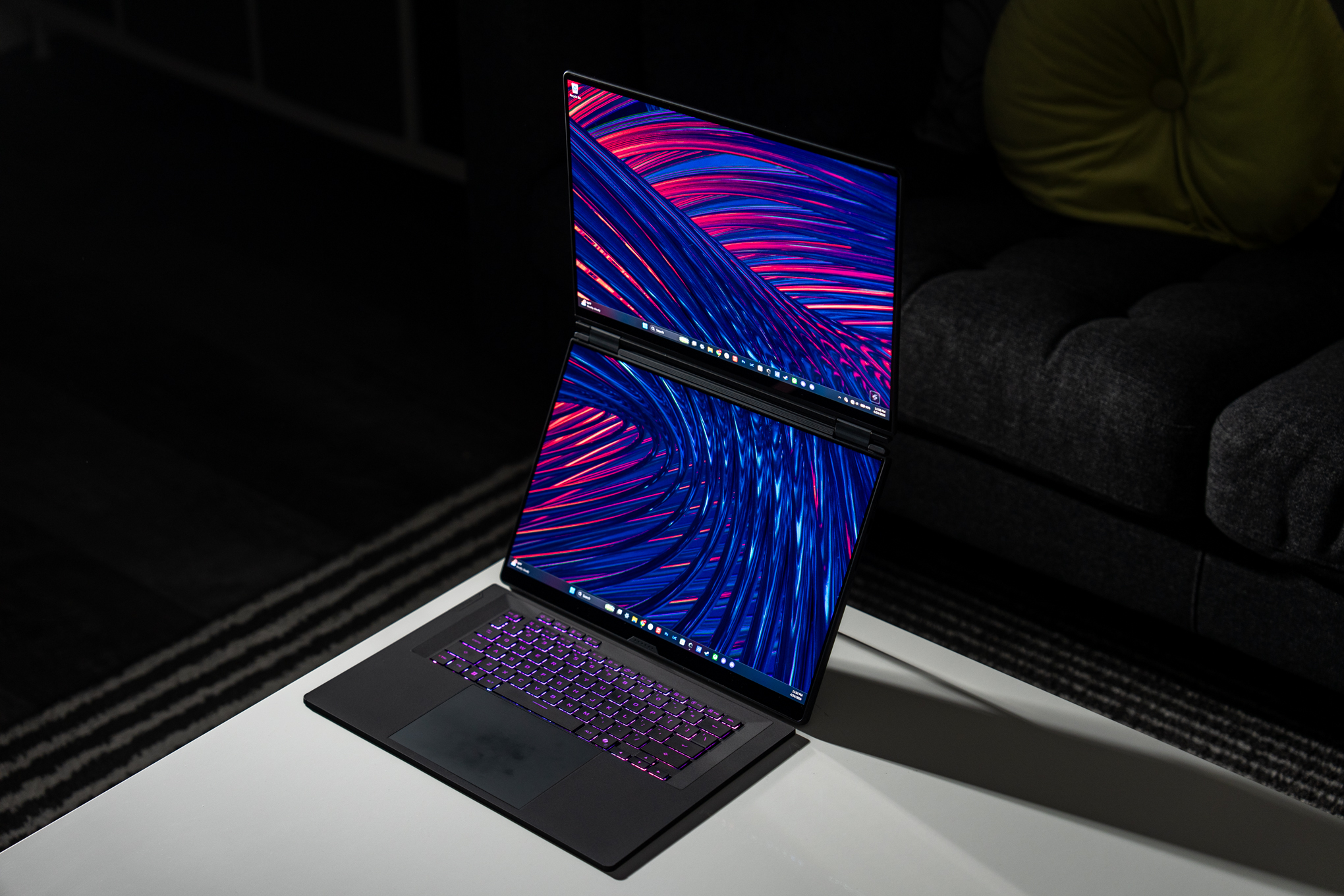

The $5,500 Asus ROG Zephyrus Duo is a dual-screen laptop that’s both intriguing and exceptional. But it’s costly.
The Asus ROG Zephyrus Duo was my top choice for the best laptop at CES: It featured two premium screens, impressive specifications, and the potential for unmatched multitasking and gaming performance. Now that I’ve tested this extravagant laptop, it lives up to my expectations and fears—it’s amazing but expensive. Our review unit is priced at $5,500.
This laptop is stacked with features: two full-size 16-inch OLED displays, an Nvidia RTX 5090 Laptop GPU, a high-end 16-core Intel Panther Lake chip, a range of ports (including an SD card slot), and a fantastic keyboard and trackpad that can be used wirelessly. These premium components add up, excluding the cost of its 32GB soldered RAM and 1TB SSD.
So who is this laptop for? Who needs a dual-screen gaming laptop? I once saw a previous Zephyrus Duo model at a retro gaming convention. Even though the owner was just browsing eBay, it felt like spotting a rare creature.
This laptop is not essential for anyone. Nobody really “needs” it or its sleeker relative, the Zenbook Duo. However, dual-screen laptops are undeniably cool and enjoyable to use. Forget practicality and embrace the potential of this portable gaming battlestation.
The Zephyrus Duo resembles an amplified version of the ROG Zephyrus G16. But lift the keyboard to reveal the second screen, and it gets interesting. Both 16-inch 2880 x 1800 touchscreen OLEDs have 120Hz refresh rates and up to 1,100 nits peak HDR brightness. The displays are gorgeous, showcasing crisp details and deep contrast.
The display setup significantly improves upon the previous-generation Zephyrus Duo 16 and the original Duo 15, which had a large main screen and a narrow secondary screen. Now, you’re always equipped with two identical full-size OLEDs. The downside: this laptop is almost an inch thick, weighing 6.17 pounds (2.8kg).
Similar to the lighter Zenbook Duo, this laptop excels at multitasking. You can easily arrange multiple windows across its screens. I enjoy using landscape mode for writing. The dual screens slightly affect other components: The speakers are mediocre, lacking bass, and the 1080p webcam struggles in low light but sits at eye level. The keyboard retains deep key travel and a satisfying feel, and the large trackpad offers a pleasant tactile response though doesn’t click all over.
The wireless keyboard and trackpad are enjoyable, providing over six hours of usage before needing a charge. However, the laptop’s battery life is shorter than the Zenbook Duo’s. Its 90Wh battery is 10% smaller, and its energy-hungry GPU and larger screens reduce efficiency. It managed 11 hours in a single-screen test, compared to the Zenbook Duo’s 14 hours.
But the Zephyrus Duo is a proper gaming laptop, featuring Nvidia’s top-tier mobile GPU. It ran Marathon smoothly at 60fps on High settings (2880 x 1800) with DLSS set to Performance. Turbo mode increased performance to 70fps+, with fans becoming louder.
Performance improved further in Battlefield 6. In Turbo mode, it maintained around 90fps on High presets without upscaling. DLSS 4.5 in quality mode boosted it to 100-110fps.
Game performance is strong, but the Zephyrus Duo’s standout feature is its second screen for multitasking: game guides, chat apps, performance monitoring, or entertainment. Although technically possible, playing a game across both screens isn’t practical due to their separation.
During gaming, I multitasked with Discord, Signal, and Chrome on the second screen. Many use external monitors for this utility, but the Duo does it portably. I enjoyed gaming on my couch, using a lap desk, external keyboard, and mouse, while my spouse watched TV. It was convenient not being confined to a desk.
However, the Zephyrus Duo I tested has a top GPU slightly limited to 135W TGP, below the RTX 5090’s 150W peak. Lighter and cheaper 5090 laptops like the Razer Blade 16 or the 2025 ROG Zephyrus G16 outperform it. Even Asus’ ROG Strix Scar 16 with lesser RTX 5080 can deliver higher performance due to better cooling, costing $1,000-$2,200 less.
This is consistent with the ROG Zephyrus line, like the G14 and G16, which trade performance for a sleeker design and better battery life, suitable for more than gaming. But the Zephyrus Duo is extremely pricey. A Razer Blade 16 with similar specs and an additional Alienware QD-OLED