

Dust in the wind.
By Elisha Sauers on May 3, 2026
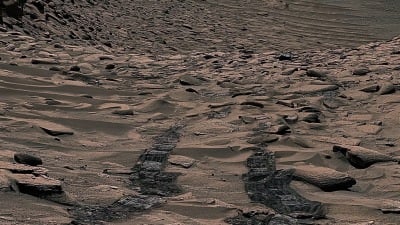
NASA’s Curiosity rover leaves tracks at Gale Crater on Mars on April 20, 2023. Credit: NASA / JPL-Caltech / MSSS
When NASA creates a new timelapse video, it’s for scientific purposes, not just for the internet. The U.S. space agency recently compiled images from Curiosity, one of its Mars rovers, into a two-minute video capturing six years of exploration at Gale Crater. The video shows the rover traversing rocky landscapes as it ascends Mount Sharp.
This montage serves as a tool for the rover’s science team. Using Curiosity’s right navigation camera views, researchers analyze sand grains shifting on the rover’s deck.
You can watch the Martian dust in the rover’s treads in the Instagram post below. “Distinguishing between sand jostled by drives and wind gusts provides new information about seasonal changes in the atmosphere,” NASA said.
Curiosity captured these images between Jan. 2 and March 8, 2020, but its mission started much earlier. After 352 million miles of space travel, it landed on Mars on Aug. 5, 2012, with a mission to determine if Mars once supported life.
The question was answered within a year. The rover’s findings from a lakebed confirm the region once had the chemistry and nutrients needed for life.
Curiosity has since been studying Mars with its chemistry lab. A recent study found 21 different organic molecules, the largest set on Mars so far, including complex carbon materials. While these could be life-related, they could also result from water-rock chemical reactions.
As scientists observe shifting sands for information on Martian seasons, engineers watch for wear on the rover. The team observed sharp rocks causing damage to Curiosity’s wheels, leading NASA to design Perseverance with sturdier wheels.
NASA also implemented techniques like reverse driving and software upgrades to manage the damage and extend Curiosity’s travels, which cover 23 miles on Mars.
Wheel damage isn’t the only challenge. Martian winds stir up dust, which can affect solar panels, as happened to Curiosity and Perseverance’s predecessors, Spirit and Opportunity.
Elisha Sauers writes about space for Mashable, covering NASA’s missions, astronauts, and discoveries. An award-winning journalist, Sauers has reported on a range of topics for 17 years. Contact her via email or text for story ideas, and follow her on X at @elishasauers.