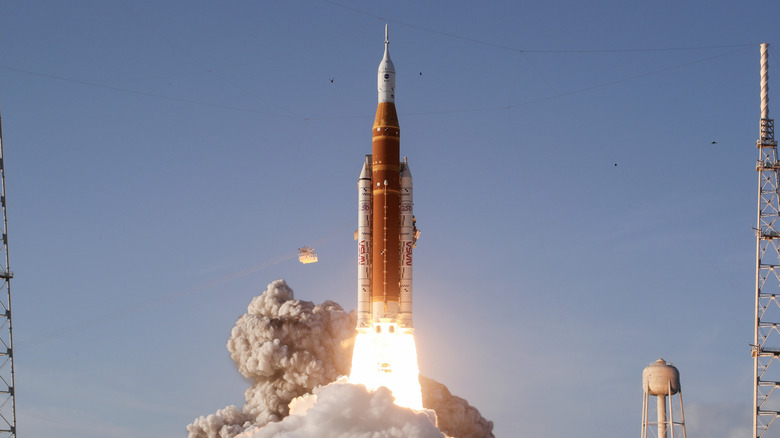

launch at curved paths to leverage the Earth’s gravitational force. Rolling is another technique rockets utilize to maintain their trajectory.
A rolling action, also referred to as a roll maneuver, arises from the rotational motions employed by all flying craft, including rockets and aircraft, for navigation. Each motion involves bending one of three axes, and these actions are identified as roll, yaw, and pitch. In aviation terms, a roll takes place when the lift on one wing surpasses that on the other, causing the aircraft to roll. The rear horizontal tail rudder manages the pitch and adjusts altitude. Simultaneously, the vertical rudder governs the yaw, rotating the aircraft sideways. While rockets do not feature wings and rudders, their roll, yaw, and pitch still influence their flight paths, which is where the rolling action is relevant.
Rockets execute a gradual, controlled roll during flight because it effectively eliminates roll from the navigation calculations. If pilots need to alter their horizontal trajectory angle relative to north (the azimuth), they only have to focus on the rocket’s pitch after executing a roll. This also conserves fuel since making mid-flight adjustments would consume more.