
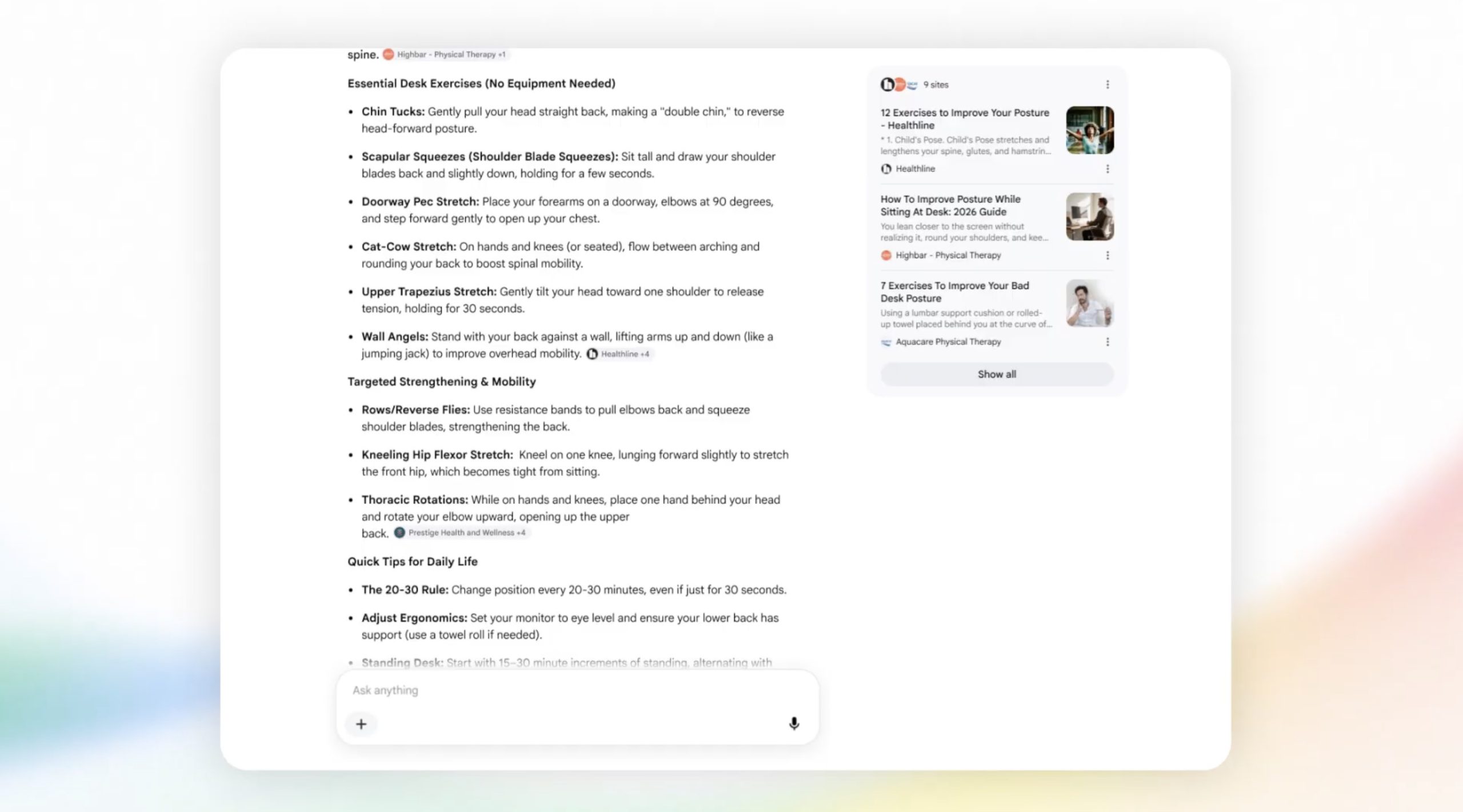

The era of simple “ten blue links” is gone. On Tuesday, Google introduced an AI-driven redesign of Search with an updated “intelligent search box”—a significant change since the search box’s creation over 25 years ago.
Now, instead of just a list of links, Google Search will offer users AI-powered interactive experiences. New tools will enable “information agents” to gather data for users and let them create personalized mini apps tailored to their needs.
The revamped experience will differ from traditional Google Search, which focused on ranked website links. The new search box will expand for longer, conversational queries, featuring an AI-driven query suggestion system to help craft complex searches.
Google also introduces AI Overviews, allowing users to ask follow-up questions in AI Mode starting Tuesday.
Google is introducing agentic and AI-driven interactive features into search, reducing dependency on traditional blue links. By summer, users can create and manage multiple new “information agents” in Google Search, working 24/7 to track web changes.
While AI powers the technology, the idea isn’t entirely new. In 2003, Google launched Google Alerts, an email-based change-detection service for new web results. Information-gathering agents advance Google Alerts, interpreting changes.
“You could send an alert to track market movements with specific parameters,” explained Google’s Head of Search, Liz Reid. “The agent will monitor and let you know when conditions are met, providing updates with links for further exploration,” she added.
This shift implies that AI agents will increasingly handle web searches more than humans, who will focus on acting on the information provided.
Links may become secondary with upcoming Search changes based on prior AI search launches, such as AI Overviews and conversational AI Mode.
AI Overviews serve over 2.5 billion monthly users, while conversational search Mode—launched last year—has over 1 billion monthly users. (ChatGPT had 900 million weekly active users earlier this year, indicating more frequent engagement with returning users weekly, while Google’s AI features gain unique monthly users.)
Thanks to Gemini and Google Antigravity, Search results will resemble interactive web pages.
“Search can create custom experiences for individual questions, from dynamic layouts to persistent project spaces,” Reid stated. Google is integrating these capabilities with “generative UI” (user interface), generating custom widgets and visualizations for searches.
For example, a question about black holes could result in an interactive visual, with Google responding with new real-time visuals to follow-up questions.
Google developed the new system with Google DeepMind using Gemini Flash 3.5. It will be widely available, free this summer.
Additionally, Google will enable Antigravity users to create customizable, stateful experiences—“mini apps”—in Search using natural language commands. This focuses on action rather than information retrieval, allowing users to build tools like meal-planning or fitness apps specific to their goals.
These changes will likely further reduce Google referrals to publishers, already affected by AI Overviews, hurting ad-reliant media businesses. Immediate adaptation is critical, as the new search box launches this week and generative UI arrives this summer, both free. Mini-app creation and information agents will initially be available to Google AI Pro and Ultra subscribers this summer.
Long-term, Google plans to broadly distribute its AI technology, including personal AI agent Spark, intended to be free, as will many AI features.
“By delivering frontier models—highly capable, efficient, and affordable—we aim to reach as many people as possible,” said Google CEO Sundar Pichai in a press briefing before I/O.
*When you purchase through links in our articles, we may earn a small commission. This doesn’t affect our editorial independence.*