
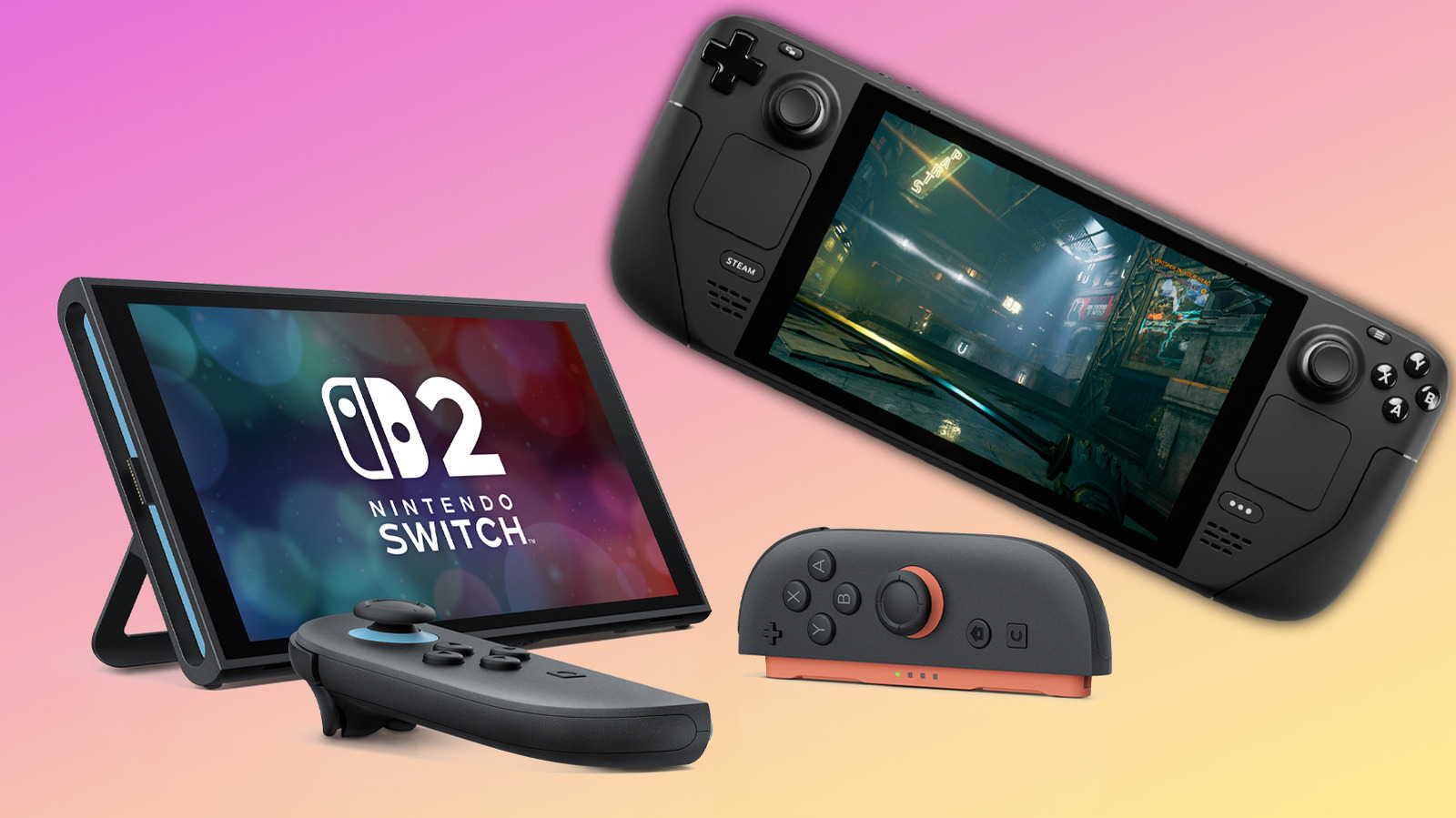

The Nintendo Switch 2 and Valve’s Steam Deck are both impressive handheld gaming devices with distinct advantages. Nintendo’s latest portable console hybrid has garnered attention for its surprisingly robust hardware, while the Steam Deck continues to be praised for its straightforward approach to PC gaming, effectively addressing game backlogs.
By 2026, the components within the Steam Deck are approximately five years old. It features a custom processor and graphics unit amalgamation, referred to as an “APU,” or Accelerated Processing Unit. Unique to Valve’s device, the APU is derived from AMD’s Zen 2 series chips, which were in production from Ryzen 3000 to Ryzen 7000. Given its age, more tech-savvy users are exploring various methods to enhance performance on the Steam Deck through clever (and cost-free) modifications.
In contrast, the Nintendo Switch 2 also utilizes older technology, but it incorporates more powerful software to bridge any performance gaps. This is due to Nintendo opting for Nvidia, integrating DLSS (Deep Learning Super Sampling), the company’s upscaling technology. With a custom Nvidia Tegra T239 GPU, the Switch 2 can manage much newer games by utilizing Nvidia’s advancements.
Steam Deck vs Switch 2 – it boils down to the software
Currently, the Switch 2 and Steam Deck are fairly similar in terms of performance. Some games may perform better on the Steam Deck, primarily because it functions as a low-powered PC. With realistic expectations, acquiring a Steam Deck in 2026 is still a worthwhile endeavor – provided you can find one.
Nevertheless, the features that the Switch 2 offers, such as DLSS, provide it with slightly more flexibility in games compared to the Steam Deck. DLSS processes the game at a reduced resolution before upscaling it to the intended output using algorithms. For example, “Pragmata” on the Switch 2 operates at 540p, but still yields a 1080p image when docked. In handheld mode, pixel-analysis experts Digital Foundry estimate it runs at about 360p to ensure smooth performance.
Another benefit is the dock for the Switch 2. The console requests a certain voltage and then activates an overclocked mode to extract more power from the hybrid. This capability allows the Switch 2 to reach up to 120Hz at a maximum resolution of 1440p or 4K at 60 frames per second (fps). Meanwhile, the Steam Deck can output up to 4K60 or 1440p120 using Valve’s dock, although it may require third-party docks to exceed those specifications.
Players are discovering methods to optimize the Steam Deck’s capabilities
One approach players are taking to enhance performance on the Steam Deck, which the heavily restricted Switch 2 cannot replicate, is through modifications. The Steam Deck’s chip can utilize AMD’s DLSS alternative, FSR (FidelityFX Super Resolution), which is officially supported up to version three. Modders have succeeded in backporting FSR 4, which is exclusive to the latest AMD GPUs, following a leak of a version. Additionally, Lossless Scaling, a paid program, has provided a significant performance boost at the expense of visuals or latency.
It’s essential to remember that the Switch 2 will have specially designed versions for its ports despite similar performance figures. Transferring a game from a PC development environment to a highly specific hardware platform like the Switch 2 will inevitably necessitate certain features to be tailored for the system. Once again using “Pragmata” as an example, hair is not rendered in a strand-based manner, but rather utilizes a more rigid card-based technology.
Furthermore, it’s important to note that Valve and the Steam Deck’s “Verified” system leaves much to be desired. Games may receive the “Verified” label only for their performance to be subpar. For instance, “Death Stranding 2” needed a mod to alleviate processor strain and make it playable, despite the badge being present. On the Switch 2, some ports have faced delays, like “Borderlands 4,” while “Elden Ring: Tarnished Edition” encountered notable performance issues.