
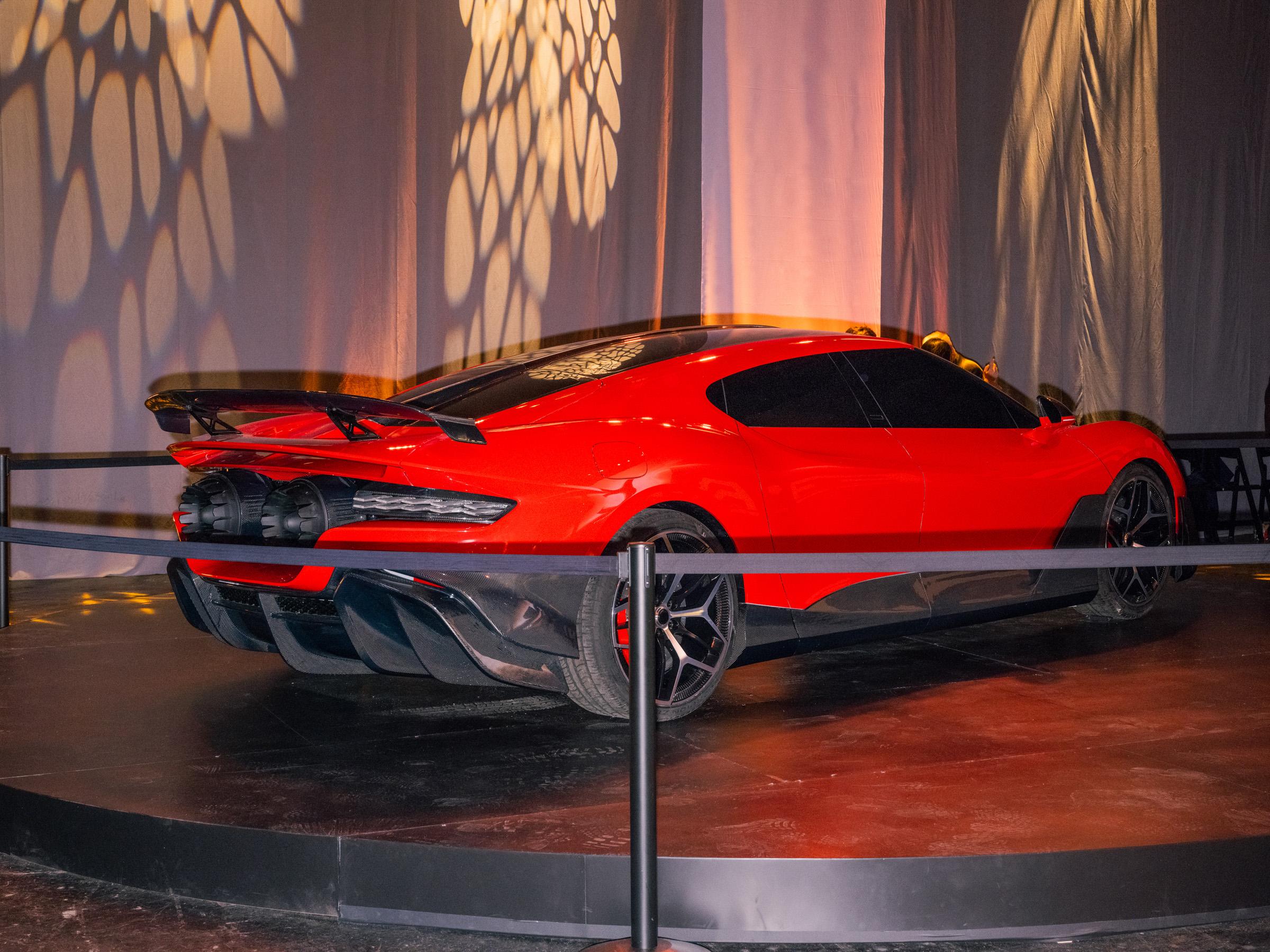

The Chinese vacuum company has automotive ambitions, but its claims of rocket-boosted acceleration are questionable.
When I first learned about a vacuum company releasing a rocket-powered electric vehicle with seemingly impossible performance specifications, I initially thought of James Dyson’s innovative ways.
However, this time it’s Dreame, a lesser-known Chinese household appliance firm with aspirations to be a global electronics leader, venturing into supercar design. Held in San Francisco, the company’s recent expo included a dramatic product presentation highlighted by an extravagant vehicle.
Previously, during CES last January, Dreame showcased a concept car with four electric motors, delivering 1,399kW (1,876 horsepower) and hitting 100km/hour in 1.8 seconds, which in itself was remarkable. Now, they’ve pushed further boundaries with their Nebula NEXT 01 Jet Edition, boasting “rocket engines” that allegedly propel from 0 to 60 mph in 0.9 seconds.
This speed supersedes any existing vehicle but presents physical impossibilities; current tire traction can’t support such acceleration. Even all-wheel drive hypercars face “traction limits.” Tires can spin due to immense horsepower but lack the necessary force for ground grip without slipping. Achieving 60 mph in under a second demands intense, immediate force. Custom-built dual solid rocket boosters supposedly provide 100 kilo-Newtons of force, but applying such force through tires remains a significant constraint unless in a vacuum or optimal conditions where physics might differ.
There are precedents in sub-1-second 0-60 acceleration; A student project by the Academic Motorsports Club Zürich and Swiss universities ETH Zürich and Lucerne University made a sub-one-second light racecar, yet weighing merely 300 pounds and without a roof.
An engineer from The Autopian, present at Dreame’s San Francisco expo, examined the Nebula NEXT 01 and criticized the credibility of Dreame’s “mock” boosters, pointing out a lack of basic aerodynamic elements like air inlets or outlets, questioning its real-world practicality.
While ambitious, Dreame faces challenges transitioning into automotive production, especially amidst stiff competition in the contracting Chinese EV market. Tesla, known for ambitious vehicle innovations, promised a “SpaceX package” for its next-generation Roadster enabling similar quickness with rocket thrust, yet their Roadster proposal remains unreleased.
Will Dreame outpace the world’s wealthiest people with their theoretical technology? If an unseen and untested vaporware vehicle claims extraordinary acceleration, does it truly exist?