
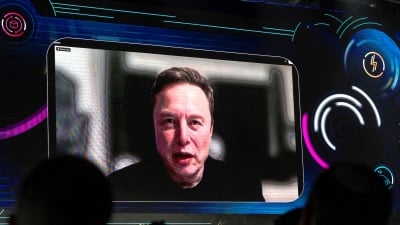

Would you consider buying an AI company that’s really a space company from this man? Possibly.
Elon Musk, who has confessed to video game cheating, might have discovered the ultimate cheat code to make him the first trillionaire in the capitalist world. This could be the case with the SpaceX IPO, for which the company submitted its SEC S1 form on Thursday. The document includes questionable claims about SpaceX’s future as an AI company and some embarrassing revelations about SpaceX, its new subsidiary xAI, and Grok. Despite this, SpaceX is still eyeing a record $1.75 trillion valuation.
What’s in the SpaceX IPO?
To understand how unusual the filing is, let’s ignore the names SpaceX, xAI, Grok, Elon, and Musk. Imagine you’re telling your financial advisor you want shares in a new space launch company. This company lost nearly $5 billion last year, on $18 billion of revenue. The revenue makes it look small, and its losses are growing. But so is its revenue, so you’re hopeful about its future.
Your financial advisor may think it’s a risky bet that could pay off. What’s the angle?
Well, you say, the CEO is all in on AI. This space launch company is really an AI company now, after it quickly merged with one of the CEO’s other companies earlier this year, described as “the smallest” of the large AI players. The merger was a financial burden that caused most of the combined company’s losses.
Still, AI’s link to the space launch business makes total sense. The CEO claims he’ll launch AI data centers in space starting in 2028. And you believe that, despite his history of making bold space predictions that never happen.
Do space AI data centers make sense? Who knows! “The conditions of space on such AI infrastructure have not been tested, by us or anyone else,” says the IPO. “Component failures could result in permanent capacity loss”—since there are no IT personnel there to fix them.
But hey, what could make these components fail in space? Apart from the list in the S-1 filing: geomagnetic storms, solar flares, cosmic radiation, micrometeorites, orbital debris, and the initial launch’s vibration and shock. Oh, and “the useful life of our satellites is inherently shorter than that of the information technology systems and infrastructure they host,” the filing says, but you’re trying not to dwell on what this means for a data center business.
SEE ALSO: Why SpaceX bought xAI: Data centers in space aren’t the only reason
Regulatory filings can be such downers! What matters is this guy really believes in his AI product, right? So much so that SpaceX’s IPO claims a $26.5 trillion addressable AI market (compared to the space launch and Starlink connectivity market, which it claims is $2 trillion). That AI product, by the way, comes in “Unhinged Voice mode” and “Spicy Imagine mode.” The IPO notes its “heightened risks” of “reputational harm,” not to mention regulatory and legal harm, from “potentially explicit content … misinformation … exploitative imagery, intellectual property infringement,” or “harmful, harassing, abusive, or discriminatory” content.
What could possibly go wrong?
Apart from the international investigations into whether this company’s product was used to create nonconsensual deepfakes of minors, which the IPO mentions. (The lawyers must have sighed deeply, but at least they didn’t mention the whole MechaHitler incident.)
Speaking of legal harm, there’s also the $3 billion in new data center gas turbine purchases revealed by the IPO, despite the company facing a big lawsuit from environmental groups for pollution. This guy has a history of winning most legal battles. Ignore the last one, where he flouted a court order by skipping off to China, and a jury found he had no right to bring the case in the first place.
Given all that information, most financial advisors would say the company isn’t worth the risk.
The cheat code at Tesla
For SpaceX, however, your financial advisor may rush to invest before you. The IPO sets aside 30 percent of shares for “retail investors,” an unusually high percentage; arguably they’re more likely to bet on a name, a personality, a legend, than a company’s fundamentals.
The reason, essentially, is “never bet against Elon Musk.” First said by fellow Paypal billionaire and friend Peter Thiel, then SpaceX investor Peter Diamandis, this phrase has been adopted by Morgan Stanley and Breyer Capital CEOs. It is a belief—literally, in articles that use it to dismiss Musk’s peculiar moves, from the Cybertruck design to the Twitter purchase. (Twitter was turned into X and then folded into SpaceX, perhaps the most buried sunk cost ever.)
Musk has mastered business showmanship. He can dance on ever-higher tightrop